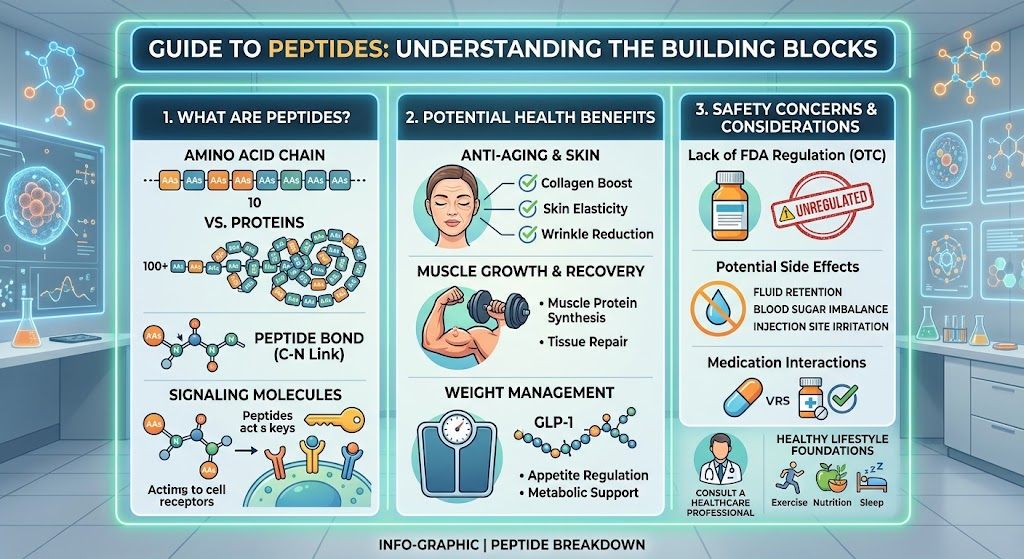
Peptides have rapidly transformed from a niche topic in biochemical research into one of the most widely discussed subjects in modern health, skin care, and anti-aging science. From collagen supplements promising glowing skin to targeted therapeutic peptide therapies and GLP-1 weight-loss medications, these bioactive compounds are reshaping how we approach wellness and disease management.
This guide breaks down what peptides are, their primary biological benefits, and the essential safety concerns to keep in mind.
What Are Peptides?
Peptides are short chains of amino acids, the organic compounds often referred to as the “building blocks” of proteins.
The difference between peptides and proteins
Both peptides and proteins consist of amino acids linked together by peptide bonds. The key structural difference lies in their size:
- Peptides: typically consist of 2 to 50 (or up to 100) amino acids arranged in a short chain. Authors differ on the exact cutoff; past about 50, a chain is usually called a protein.
- Proteins: long, complex chains often containing hundreds or thousands of amino acids folded into specific shapes.
Because peptides are smaller and less complex than full-length proteins, they are often described as easier for the body to absorb. That is only partly true. Healthy skin generally keeps out molecules heavier than about 500 daltons, which excludes most peptides, and in the gut peptides are easily broken down by digestive enzymes. That is why most peptide drugs are given by injection.
Peptides as signaling molecules
In the human body, naturally occurring peptides act as critical signaling molecules. They send precise messages across cells to regulate vital processes including metabolism, tissue repair, immune response, and hormone release. Examples of naturally produced peptides include:
- Insulin: regulates blood sugar levels.
- Ghrelin: a stomach peptide that triggers the release of growth hormone. Synthetic growth hormone secretagogues (GHS) act on the same receptor.
- Antimicrobial peptides (AMPs): made by epithelial cells in the skin and the linings of the airways, gut and urinary tract, they help protect skin and mucous membranes against bacteria and fungi.
Key Potential Health Benefits of Peptides
Bioactive and synthetic peptides are studied for a broad spectrum of physiological effects, depending on their specific molecular sequence. The strength of the evidence varies widely, from large trials of prescription drugs to animal studies alone.
| Benefit category | Associated peptides & mechanisms | Primary effects |
|---|---|---|
| Anti-aging & skin health | Collagen peptides, copper peptides (GHK-Cu), AMPs | Studied for skin elasticity, wrinkle depth, hydration, and barrier repair; results in human trials are mixed. |
| Muscle growth & recovery | BPC-157, growth hormone secretagogues | Tendon and ligament repair in animal studies (BPC-157); increased lean body mass in a trial of the oral secretagogue MK-677. |
| Weight & metabolic management | GLP-1 agonists (e.g. semaglutide, tirzepatide) | Slows gastric emptying, boosts glucose-dependent insulin release, and reduces appetite. |
| Bone density & joint support | Bioactive collagen hydrolysates | Raised bone mineral density in postmenopausal women in one trial; modestly eases osteoarthritis pain and improves function. |
| Immune & antimicrobial defense | Antimicrobial peptides (AMPs), thymosin beta-4 | Help combat harmful pathogens; also studied for immune regulation and wound healing. |
Peptides for skin and anti-aging
This is where most people first encounter the category. Collagen peptides are studied for skin elasticity and hydration, copper peptides (GHK-Cu) for barrier repair, and antimicrobial peptides for their protective role on the skin surface. The idea behind most of these products is signaling: the peptide is meant to prompt skin cells toward repair. How well that works in people is less settled. A 2025 meta-analysis of 23 randomized trials found that collagen supplements helped skin only in industry-funded and lower-quality studies; independent and high-quality trials showed no significant effect.
Peptides for muscle growth and recovery
BPC-157 and growth hormone secretagogues are the names most often linked to muscle and tendon recovery. Recovery, rather than raw size, is the effect most often described, but the human evidence is thin. A 2025 systematic review of BPC-157 found 35 preclinical studies, one small clinical study, and no clinical safety data. Among the secretagogues, the oral compound MK-677 increased lean body mass in a two-year trial of older adults, while also raising fasting blood sugar.
GLP-1 peptides for weight and metabolic management
GLP-1 agonists such as semaglutide and tirzepatide copy a gut hormone that slows gastric emptying, boosts insulin release when blood sugar is high, and reduces food intake. Tirzepatide also activates the receptor for a second gut hormone, GIP. These are prescription medications, and the safety notes below apply to them in particular.
Types of Peptides: Dietary, Topical, and Synthetic
- Dietary peptides: found naturally in protein-rich foods (milk, fish, meat, soy, beans) or taken as oral dietary supplements like hydrolyzed collagen powder.
- Topical peptides: included in anti-aging serums and moisturizers, intended to encourage localized collagen production and skin repair.
- Therapeutic / synthetic peptides: lab-formulated compounds delivered via subcutaneous injection or nasal spray under medical supervision for clinical interventions.
Safety Concerns, Side Effects, and Regulations
Many dietary peptide supplements, collagen among them, are generally well-tolerated by healthy individuals. Synthetic peptide therapies require far more careful consideration.
Are dietary peptide supplements FDA approved?
Not in the way prescription peptide drugs are. Unlike peptide medications approved by regulatory agencies, over-the-counter dietary supplements are not approved for safety or efficacy before they reach the market; the FDA does not have the authority to approve them in advance. Manufacturers are responsible for their products and must follow good manufacturing practices, but no regulator confirms that a supplement works before it goes on sale. Approval and marketing clearance are not the same thing, and the difference matters most when you are injecting rather than eating something.
Potential side effects
Depending on the route and type of peptide used, side effects may include:
- Fluid retention and joint pain.
- Blood sugar or hormonal imbalances, especially with unmonitored growth hormone peptides. In one trial, MK-677 raised fasting blood sugar and lowered insulin sensitivity.
- Nausea, headache, or injection-site irritation.
The risk of unregulated “research chemicals”
Online platforms frequently sell unapproved peptides labeled for “research use only.” The FDA has warned companies selling unapproved GLP-1 drugs falsely labeled “for research purposes,” and cautions that illegally marketed products like these may contain the wrong or harmful ingredients, or too little, too much, or none of the active ingredient. Third-party lab testing is the only practical way to know what is actually in a vial.
Athletic bans
Many growth hormone secretagogues and anabolic peptides appear on the World Anti-Doping Agency (WADA) prohibited list, which names ibutamoren (MK-677) among growth hormone releasing factors and BPC-157 among non-approved substances banned at all times. Competing athletes should treat that list, not a vendor’s product page, as the authority.
Supporting Your Body’s Natural Peptides
Before opting for supplementation or therapy, foundational lifestyle habits naturally optimize endogenous peptide production:
- Resistance exercise: weight training naturally triggers growth hormone release and muscle repair signals.
- Balanced nutrition: consuming adequate complete proteins provides the amino acids your body needs to construct its own peptides.
- Prioritizing sleep: deep sleep cycles are crucial for hormone regulation and tissue repair.
Always consult a qualified healthcare professional before starting any peptide regimen or synthetic therapy, to evaluate potential drug interactions, underlying health conditions, and appropriate dosages.
Sources
- IUPAC-IUB Joint Commission on Biochemical Nomenclature: Nomenclature and Symbolism for Amino Acids and Peptides, rule 3AA-11 (1983): where peptides end and proteins begin, and why authors differ.
- Therapeutic peptides: current applications and future directions (Signal Transduction and Targeted Therapy, 2022): weak membrane permeability, breakdown by digestive enzymes, and why most peptide drugs are injected.
- The 500 Dalton rule for the skin penetration of chemical compounds and drugs (Experimental Dermatology, 2000): why larger molecules do not pass the skin’s outer layer.
- Ghrelin is a growth-hormone-releasing acylated peptide from stomach (Nature, 1999): ghrelin as the body’s own growth hormone releasing peptide, and secretagogues as synthetic molecules.
- Antimicrobial peptides: mechanism of action, activity and clinical potential (Military Medical Research, 2021): where human antimicrobial peptides are made and their roles beyond killing microbes.
- Effects of Collagen Supplements on Skin Aging: A Systematic Review and Meta-Analysis of Randomized Controlled Trials (American Journal of Medicine, 2025): 23 trials, with benefits limited to industry-funded and lower-quality studies.
- Emerging Use of BPC-157 in Orthopaedic Sports Medicine: A Systematic Review (HSS Journal, 2025): 35 preclinical studies, 1 clinical study and no clinical safety data.
- Effects of an oral ghrelin mimetic on body composition and clinical outcomes in healthy older adults (Annals of Internal Medicine, 2008): MK-677 increased fat-free mass but raised fasting glucose, lowered insulin sensitivity, and caused edema and muscle pain more often than placebo.
- Glucagon-like peptide 1 (GLP-1) (Molecular Metabolism, 2019): GLP-1’s effects on insulin secretion, gastric emptying and food intake.
- FDA Approves New Medication for Chronic Weight Management (FDA, 2023): tirzepatide’s action on GLP-1 and GIP receptors, and its common side effects.
- Specific Collagen Peptides Improve Bone Mineral Density and Bone Markers in Postmenopausal Women (Nutrients, 2018): 12-month randomized trial of 5 g collagen peptides daily.
- Efficacy and safety of collagen derivatives for osteoarthritis: A trial sequential meta-analysis (Osteoarthritis and Cartilage, 2024): small-to-moderate effects on pain and function across randomized trials.
- Questions and Answers on Dietary Supplements (FDA): no pre-market approval of supplements, and the manufacturing rules that do apply.
- FDA’s Concerns with Unapproved GLP-1 Drugs Used for Weight Loss (FDA): products falsely labeled “for research purposes” and the risks of illegally marketed drugs.
- The Prohibited List (World Anti-Doping Agency): growth hormone releasing factors under S2 and BPC-157 under S0.