GHK-Cu is one of the most discussed compounds in peptide research circles. You will find it in skincare serums and in freeze-dried research vials. The claims around it run from firmer skin to “resetting” your genes. This guide sorts the published research by how strong it is, so you can tell data from marketing.
What Is GHK-Cu?
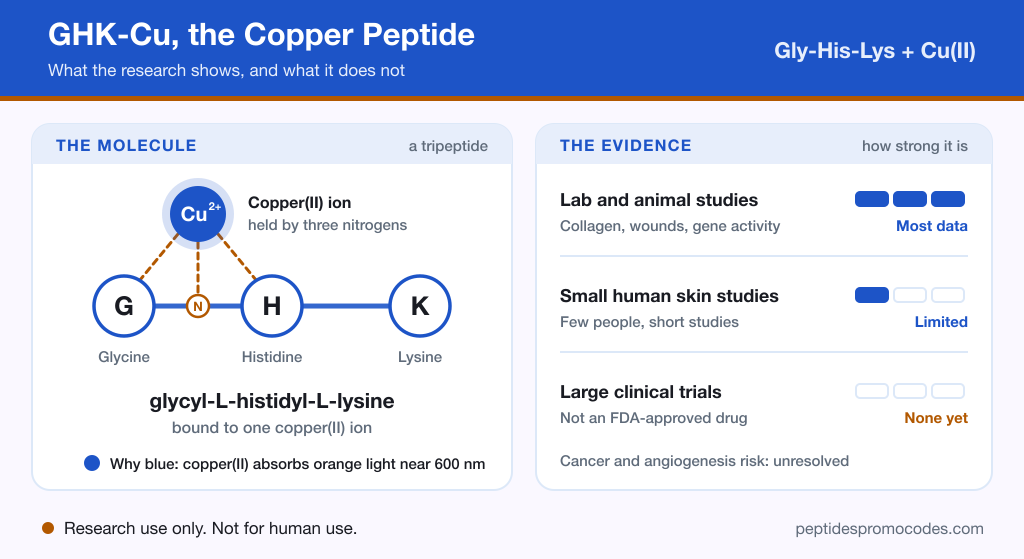
GHK-Cu is a small copper peptide: three amino acids (glycine, histidine and lysine) bound to one copper(II) ion. Its full name is glycyl-L-histidyl-L-lysine copper. It occurs naturally in human blood plasma. Skincare labels list it as copper tripeptide-1, and it is also sold in vials as a research chemical.
Where it came from
Loren Pickart first reported the molecule in 1973. He found a factor in human plasma that made liver tissue from older people produce proteins more like younger tissue. Later work showed the factor was a tripeptide (a chain of three amino acids) with a strong pull for copper.
NIH PubChem, a public chemistry database, files it as prezatide copper. Its other listed names include GHK-Cu and copper tripeptide-1.
Does it decline with age?
Pickart’s reviews report that plasma GHK falls from about 200 ng/mL at age 20 to about 80 ng/mL by age 60. His group links that fall to weaker tissue repair with age. But a drop with age is a correlation. It does not show that adding GHK-Cu back reverses aging.
Why Is GHK-Cu Blue?
The blue comes from the copper, not the peptide chain. Copper(II) bound to GHK absorbs light near 600 nm, which is orange light. Your eye sees the light that is left, and that looks blue. A 2014 Cosmetic Ingredient Review (CIR) safety report describes collecting the purified complex at the peak absorbing at 600 nm. It describes the crystals as dark blue-purple.
Chemists use that absorption to track the copper. In a 2021 Inorganic Chemistry study, glutathione (a natural reducing agent) turned some of the copper(II) in GHK-Cu into copper(I), and the blue band shrank.
Blue only tells you copper(II) is present. Common copper salts also make blue solutions in water. Color cannot confirm that the peptide is intact, correctly made or pure.
GHK-Cu vs Copper Peptides in Skincare: Which Forms Exist?
The cosmetic ingredient
On a skincare label, GHK-Cu appears as copper tripeptide-1. The CIR expert panel reviewed it in 2014 alongside related ingredients. These include tripeptide-1 (GHK without copper) and palmitoyl tripeptide-1 (GHK with a fatty acid attached and no copper). So “copper peptide” on a label does not always mean the same molecule.
The panel noted that peptides in this group are usually used below 10 parts per million in cosmetics. It concluded they are safe “in the present practices of use and concentration in cosmetics.”
Skin penetration is a separate question. GHK-Cu dissolves easily in water but poorly in fats, and the skin’s outer layer is fatty. Two 2025 reviews, in Molecules and BioImpacts, call the permeation data limited and survey liposomes and microneedles as ways to improve it.
Research vials
Research suppliers sell GHK-Cu as a freeze-dried (lyophilized) powder in sealed vials. These are neither cosmetics nor medicines. Research peptides, GHK-Cu vials included, are for laboratory research use only, not for human or veterinary use. Cosmetic GHK-Cu products are regulated separately, as cosmetics. Our guide to research peptides explains that category.
What Does GHK-Cu Research Actually Show?
The evidence falls into tiers of very different weight.
Cell and animal studies
This is the largest body of work. French researchers found that GHK-Cu at very low (nanomolar) levels stimulated both the build-up and breakdown of collagen in cell cultures, as Pickart’s 2015 review summarizes. A 2005 Stanford lab study found fibroblasts (the cells that make collagen) grew faster with GHK-Cu. Radiation-damaged fibroblasts also made more of two growth factors, bFGF and VEGF. VEGF is a key signal for new blood vessel growth.
In animals, GHK-Cu improved wound healing in rabbits and rats, according to the 2018 review. A 2026 systematic review in Aesthetic Surgery Journal found the preclinical data consistent: more collagen and matrix production, plus more blood vessel growth.
Small human skin studies
The human skin data are thin. Pickart’s 2018 review lists these studies:
- Facial cream, 71 women, 12 weeks: improved skin density, thickness, laxity and fine lines.
- Eye cream, 41 women, 12 weeks: did better than placebo and a vitamin K cream on lines and wrinkles.
- Pilot biopsy study: collagen production rose in 70% of women using a GHK-Cu cream, versus 50% with vitamin C cream and 40% with retinoic acid.
The first two are cited from a 2002 dermatology meeting’s proceedings, not from full journal papers. The BioImpacts review also found “a surprising absence of clinical studies” of GHK-Cu in anti-wrinkle products. The 2026 systematic review included 20 studies. Only 2 were randomized controlled trials.
One wound trial in people
A 1994 multicenter, placebo-controlled trial tested a GHK-Cu gel in people with diabetic foot ulcers. Everyone also got standard wound care. For ulcers on the sole of the foot, median closure was 98.5% with the gel versus 60.8% with the vehicle (the same gel without the active ingredient). That is one trial from over 30 years ago.
Gene-expression studies
The boldest claims come from the Connectivity Map. This Broad Institute database records how five cancer cell lines change their gene activity after exposure to 1,309 compounds. Researchers then match those patterns against disease “signatures.”
- Colon cancer (2010): GHK was one of two compounds whose pattern reversed a gene signature linked to metastasis.
- Emphysema (2012): a Boston University-led team found GHK reversed a lung-damage gene signature. In the lab, it restored collagen remodeling by fibroblasts from COPD lungs.
- Broad gene effects (2018): Pickart and Margolina reported that GHK changed the activity of 31.2% of human genes by 50% or more.
These are useful leads. But they come from cell lines in a dish. A change in gene activity is not the same as an effect in a person.
Evidence at a glance
| Claim | Type of evidence | Strength |
|---|---|---|
| Boosts collagen and skin matrix | Cell cultures from several labs | Consistent in the lab, not tested at scale in people |
| Supports wound repair | Animal studies, one 1994 human ulcer trial | Limited in humans |
| Improves wrinkles and skin density | Small cosmetic studies, 2 randomized trials | Low |
| “Resets” gene expression | Connectivity Map data from cancer cell lines | Hypothesis only |
| Fights cancer | Gene-expression analyses and cell studies | Very low |
| Raises cancer risk through blood vessel growth | Biology and cell data | Very low, unresolved |
| Safe as a cosmetic ingredient | CIR panel review at low use levels | Reasonable for that use |
| Safe for injection | Limited human data, per the FDA | Unknown |
What GHK-Cu Research Does Not Show
- No large, long-term human trials. The 2026 systematic review called for “larger, controlled trials with standardized formulations.”
- No drug approval. GHK-Cu is not an FDA-approved drug for any use.
- No proof of anti-aging in people. Plasma decline, cell data and gene maps are not a tested outcome.
- Limited independent confirmation. The 2012, 2015 and 2018 reviews behind many claims come from Pickart, the discoverer, and colleagues. Independent reviews are more cautious.
Is GHK-Cu Safe? Side Effects and Open Questions
In cosmetics
The CIR panel based its “safe” conclusion on low use levels plus negative tests for irritation, allergy and DNA damage. That conclusion covers cosmetics at those levels. It says nothing about other routes or much higher amounts.
Stinging and irritation
Stinging or redness after copper peptide products is a common question in peptide research communities. Published data can’t say how often it happens. The BioImpacts review found no published studies on GHK-Cu side effects. In a 2016 lab study in Scientific Reports, GHK-Cu did not raise irritation markers in skin cells. Copper chloride and copper acetate did, at the same concentrations. Cells in a dish are not your face, though.
Copper exposure
Copper is essential, but loose copper ions may increase oxidative damage, as Pickart’s 2012 review notes. His 2015 review says copper’s redox (electron-swapping) activity is “silenced” once it is bound to GHK. We found no human studies that measured copper levels after non-topical GHK-Cu use.
Injectable use and the FDA
The FDA has raised concerns about compounded injectable GHK-Cu. Its safety-risk page says such products “may pose risk for immunogenicity due to the potential for aggregation and peptide-related impurities.” Immunogenicity means triggering an immune reaction. The agency adds: “There are limited data in humans to inform safety-related considerations.” The page now lists GHK-Cu as a nomination that was later withdrawn, with that warning intact.
GHK-Cu and Angiogenesis: Is There a Cancer Risk?
Whether GHK-Cu’s effect on angiogenesis raises cancer risk is a common question in peptide research communities. Angiogenesis means new blood vessel growth. Tumors rely on it to grow and spread.
Why the concern exists
- GHK-Cu increased blood vessel growth in animal wound studies and raised VEGF output in fibroblasts.
- Copper itself matters. A 2009 review notes that depleting copper inhibited angiogenesis in many cancer cell and animal tumor models. Several clinical trials have tested copper-lowering drugs in cancer.
- Pickart’s first paper, in 1973, reported that the tripeptide stimulated growth in cancerous liver tissue as well as supporting normal liver cells.
- The CIR report cites data that GHK stimulated growth of two human tumor cell lines, but not a normal cell line. It found no published carcinogenicity (cancer-causing) data for these ingredients.
The case against the concern
- Pickart’s reviews describe anti-cancer activity, citing the colon cancer gene-signature finding and a cell study where GHK slowed neuroblastoma cell growth.
- They cite work showing GHK-type peptides released during healing stimulate vessel growth early but inhibit it later.
- Pickart’s 2015 review states that “no issues have ever arisen” from cosmetic use or human wound studies.
What is actually known
Neither side has long-term human data. The worry rests on basic biology and cell studies. The reassurance rests on gene maps and cell studies, largely compiled by the molecule’s discoverer. We found no study testing whether GHK-Cu changes cancer risk in people. Treat both “it causes cancer” and “it fights cancer” as unproven.
Stability and Handling Notes for Research Vials
Published stability work on GHK-Cu is limited. The BioImpacts review summarizes a 2016 preformulation study:
- pH: no detectable breakdown in water-based solutions at pH 5.5 and 7.4 over 14 days at 60 °C.
- Oxidation and alkali: faster breakdown under oxidative and alkaline stress. Only 84.2% remained after one hour in dilute hydrogen peroxide at 22 °C.
- Other ingredients: a negatively charged lipid, dicetyl phosphate, made it less stable.
As noted above, reducing agents such as glutathione can turn its copper(II) into copper(I). The CIR report adds that GHK breaks down quickly in plasma. We found no published data on how light affects GHK-Cu specifically.
For general storage and dissolving issues, see peptide reconstitution problems and our guide to bacteriostatic water.
How to Judge a GHK-Cu Product’s Quality
Blue color is not a quality test. Look for evidence instead:
- A batch-specific certificate of analysis (COA). It should show identity by mass spectrometry and purity by HPLC. Our guide on how to read a peptide COA explains each line.
- Confirmation of the copper complex. The method CIR describes pairs the peptide with copper at a 1:1 ratio, then removes excess copper. A report that only confirms bare GHK tells you less.
- Independent testing. An older report cited by CIR found commercial GHK about 95% pure, with small amounts of impurities likely left over from synthesis. See peptide testing labs for what third-party labs check.
- Honest labeling. Research vials should say research use only. Health claims on a research product are a red flag. Our peptide scams guide lists others.
Frequently Asked Questions
What is GHK-Cu used for in research?
Researchers study it in cell and animal models of skin repair, wound healing, collagen and gene activity. In cosmetics, it is an ingredient called copper tripeptide-1. It is not an approved drug for any condition.
Why is GHK-Cu blue?
The copper(II) ion absorbs orange light near 600 nm, so the complex looks blue. Blue shows copper(II) is present. It does not prove purity or that the peptide is intact.
Is GHK-Cu safe?
A 2014 CIR expert panel found copper tripeptide-1 safe in cosmetics at typical low use levels. Beyond that, human safety data are limited. The FDA has noted limited human data for injectable GHK-Cu.
Does GHK-Cu cause cancer?
No human study has shown that it does or that it doesn’t. The concern comes from its effect on blood vessel growth and copper’s role in tumors. Anti-cancer claims come from gene-expression and cell studies, not trials.
Is GHK-Cu the same as the copper peptides in skincare?
Usually, but not always. “Copper peptide” on a label usually means copper tripeptide-1, which is GHK-Cu. Related GHK ingredients, such as palmitoyl tripeptide-1, contain no copper.
New to peptides? Start with what peptides are, then use our buyer’s guide to vet any supplier in the directory.
Sources
- Regenerative and Protective Actions of the GHK-Cu Peptide in the Light of the New Gene Data (Int J Mol Sci, 2018): Pickart and Margolina’s review of skin studies, gene data and the anti-cancer argument.
- GHK Peptide as a Natural Modulator of Multiple Cellular Pathways in Skin Regeneration (BioMed Res Int, 2015): discovery, plasma levels, copper binding and safety statements.
- Topically applied GHK as an anti-wrinkle peptide: advantages, problems and prospective (BioImpacts, 2025): independent review of clinical gaps, skin permeation and stability data.
- The Regenerative Potential of GHK-Cu in Aesthetic Medicine (Aesthetic Surgery Journal, 2026): systematic review of 20 studies, 2 of them randomized trials.
- Safety Assessment of Tripeptide-1, Hexapeptide-12, their Metal Salts and Fatty Acyl Derivatives (Cosmetic Ingredient Review, 2014): cosmetic safety conclusion, use levels, preparation and tumor-cell data.
- Copper and Angiogenesis: Unravelling a Relationship Key to Cancer Progression (Clin Exp Pharmacol Physiol, 2009): copper’s role in blood vessel growth and cancer models.
- Certain Bulk Drug Substances for Use in Compounding that May Present Significant Safety Risks (FDA): the FDA’s safety note on injectable GHK-Cu.
- Prezatide copper compound record (NIH PubChem): identifiers and synonyms, including copper tripeptide-1 and GHK-Cu.