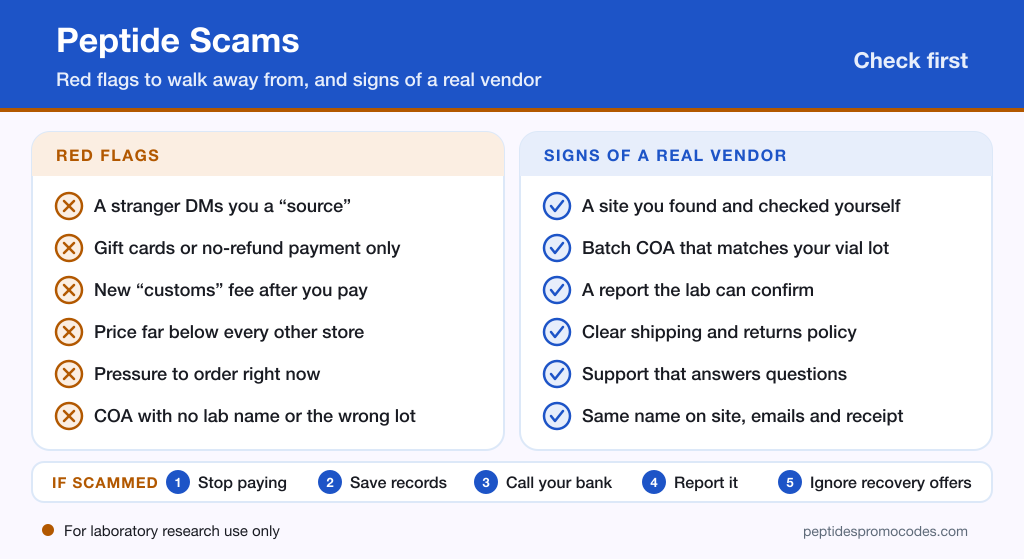
Peptide scams are common in the research peptide market, and most of them look alike. A stranger offers a “trusted source”. A website copies a real store. A fee shows up after you pay. Once you know the patterns, you can check any vendor calmly before you spend a cent.
How do you spot a peptide scam? Assume anyone who messages you first is a scammer. Walk away from sellers who rush you, want gift cards, or ask for new “customs” or “reshipping” fees after you pay. A real vendor has a traceable website, lab reports that match your vial’s lot number, clear policies and support that answers.
Research peptides are sold for laboratory research use only. They are not for human or veterinary use.
What Do Peptide Scams Look Like?
Most peptide scams are ordinary online fraud. The FTC names four signs that fit almost every scam. The scammer pretends to be someone you trust, invents a problem or a prize, pressures you to act now, and tells you to pay a specific way.
A stranger messages you first
Private messages about “trusted sources” or a “plug” are a common opening. They arrive on Telegram, WhatsApp, Discord, Instagram or Reddit, often right after you ask a question in public. That is why peptide research communities warn against asking for sources in open threads. A public request tells scammers you are ready to buy.
The FTC notes that scammers like social media because they can stay anonymous or pretend to be someone else. A real vendor does not need to chase you into your inbox. Don’t reply. Find the vendor’s website yourself and run the checklist below.
Fake group buys
A group buy pools orders from many buyers to reach a bulk price. Scammers copy the format. An organizer you have never met collects everyone’s money, often in crypto, then posts delays and excuses, or goes quiet. If you can’t confirm who holds the money and who ships the order, stay out.
Clone and look-alike websites
Some scam sites copy a real store’s name, logo and photos, then change one letter in the web address. The Canadian Anti-Fraud Centre (CAFC) warns that counterfeiters build websites with “the same look and feel” as a real brand. The FTC points out that HTTPS means a site is encrypted, not that it is honest. Type the address yourself or use a bookmark, and ignore “support” accounts that message you first.
Fake reviews and testimonials
The FTC suggests watching for a burst of reviews in a short time, and for reviewers whose account exists to post just one review. Screenshots of happy customers on the seller’s own channel prove nothing, because the seller controls what you see.
Payment you can’t get back
The FTC warns that scammers push you to pay by gift card, wire transfer, payment app or cryptocurrency, because that money is hard to recover. Crypto payments also lack the legal protections of credit and debit cards. A store that asks for gift cards is not a store.
Some research suppliers only take crypto or bank transfers, so that alone doesn’t prove a scam. It does mean the risk sits with you, so every other check matters more.
Fees that appear after you pay
Your parcel is “held at customs”, or it was “seized” and a reshipment needs a fee. Some sellers blame a customs crackdown. Then a second fee appears, then a third. The CAFC describes the same pattern in other online sales scams: you are asked to send “one payment after another” for shipping, certificates or insurance, and the goods never arrive. A real vendor quotes shipping at checkout and fixes problems through its own support.
Prices far below market, plus pressure
A price far below other vendors is a warning, not a win. The CAFC’s rule of thumb is simple: if a price is too good to be true, it is. Pressure is the other half: “last batch”, “price goes up tonight”. The FTC lists pressure to act now as a core scam sign. Legit vendors make it easy to check them and don’t rush you.
Recycled COAs and relabelled vials
A certificate of analysis (COA) is the lab report for one batch. Scammers reuse old reports, edit the lot number, or show a report for a different product. Watch for a COA with no named lab, an old test date, or a lot number that doesn’t match your vial.
Relabelling is quieter. In one story often told in peptide research communities, a clinic says its peptides are “professional use only” and not sold to the public. Then a QR code on the vial leads to an online research store selling the same vial for far less. Look-alike labels also turn up on accessories such as bacteriostatic water.
Human-use claims on “research” products
A seller that labels a product “research use only” and then offers human dosing advice is contradicting itself. The FDA has warned companies that sold unapproved drugs “falsely labeled ‘for research purposes’ or ‘not for human consumption.’” Treat that mix as a red flag.
Is This Peptide Vendor Legit? A Checklist
Run these checks before your first order. A real business passes them easily.
- Domain age and contact details. ICANN Lookup shows when a domain was registered. A site created last month that claims years of trading doesn’t add up. The CAFC lists a missing phone number or email as a red flag.
- Per-batch COAs that match your vial. Each batch should have its own report with a lot number, test date, testing lab and method. The lot number on your vial should match it. Our guide on how to read a peptide COA explains each field.
- Independent lab verification. A named third-party lab beats in-house testing. Some labs let you confirm a report on their website. If the lab can’t confirm it, treat it as unverified. Can’t afford your own test? Lean on reports you can verify, and see our guide to peptide testing labs.
- Clear policies. Shipping destinations and times, a returns or reshipment policy, and a plain research-use-only statement should be easy to find.
- Reachable support. Send a technical question before you order. Quick, specific answers are a good sign. Vague replies or silence are not.
- Consistent branding and labels. The store name should match across the website, order emails and your bank statement. The CAFC flags an odd name on your card statement, and packaging with no labels, as warning signs.
- A real payment trail. You should get an order confirmation and receipt from the store’s own domain. Sending money to a private account after a chat is not a payment trail.
- A quick search. The FTC suggests searching the company name with words like “complaint” or “scam” before you buy.
What Should You Do If You Think You’ve Been Scammed?
Stay calm and act quickly. These steps follow FTC and CAFC advice.
- Stop paying. Don’t send any new customs, reshipping or “release” fee.
- Keep records. Save order emails, receipts, chats, usernames and screenshots of the website. For crypto, also save the wallet address, transaction ID, amount and time.
- Contact whoever moved your money. Ask them to reverse the payment. The table below shows who to call first.
- Report it. In the US, report to the FTC at ReportFraud.ftc.gov and to the FBI’s IC3 at ic3.gov. In Canada, report to the CAFC through Report Cybercrime and Fraud or on 1-888-495-8501, and get a file number from your local police. In the UK, use Report Fraud, which replaced Action Fraud in December 2025.
- Report the account on the platform. Use the report option on Telegram, WhatsApp, Discord or wherever the seller found you.
- Ignore recovery offers. The CAFC warns that fraudsters often target victims again with a promise to recover their money. The FTC says never to pay upfront for help getting a refund.
| How you paid | Who to contact first |
|---|---|
| Credit card | Your card issuer |
| Debit card, bank transfer or Zelle | Your bank or credit union |
| Payment app | The payment app |
| Gift card | The gift card company (keep the card and receipt) |
| Cryptocurrency | The exchange or crypto ATM operator you used |
How Does Our Directory Vet Peptide Stores?
Our supplier directory does much of this checking for you. Every store faces the same four checks before it is listed, and again afterwards:
- Screening: how long the vendor has traded, who runs it, and whether its policies are published in plain sight.
- Documentation: third-party COAs showing the testing lab, method, batch and date.
- Ordering experience: shipping, packaging, payment methods, and how quickly support responds.
- Monitoring: listings are re-checked on a rolling schedule. A vendor that slips below the standard comes down.
Rankings are not for sale, and paid placements don’t affect who gets listed. The full method is in our buyer’s guide. A listing is a starting point, not a guarantee, so keep checking addresses and lot numbers. If you spot a clone site using a listed store’s name, tell us.
Frequently Asked Questions
Is it safe to buy from a peptide seller who messaged me on Telegram?
Treat it as a scam. Real vendors don’t need to find buyers through unsolicited messages. Don’t reply. Find the vendor’s website yourself and run the checklist above.
Does paying with crypto mean a vendor is fake?
Not by itself, since some research suppliers only take crypto or bank transfers. But crypto lacks the protections of a card payment, so check the vendor more carefully. Never pay by gift card.
How can I tell if a peptide COA is fake?
Check that it names the testing lab, shows a recent test date, and has a lot number that matches your vial. Then confirm the report with the lab that issued it. A COA the lab can’t confirm is not evidence.
The seller says my parcel is stuck in customs and wants a fee. What should I do?
Don’t pay. New payment demands after checkout are a classic scam pattern. Save the messages and contact your bank or payment provider.
Compare vetted stores in our supplier directory, see how we check them in the buyer’s guide, and learn how to read a peptide COA. Once your materials arrive, the Peptide Reconstitution Calculator handles the concentration math.
Sources
- FTC: How To Avoid a Scam: the four signs of a scam, including pressure and requests to pay a specific way.
- FTC: Online Shopping: researching sellers, why HTTPS doesn’t prove a site is real, and payment methods to avoid.
- FTC: How To Evaluate Online Reviews: signs that reviews may be fake.
- FTC: What To Do if You Paid a Scammer: who to contact for each payment method, and how to report.
- Canadian Anti-Fraud Centre: Merchandise: look-alike websites, repeated payment demands and counterfeit red flags.
- Canadian Anti-Fraud Centre: What to do if you’re a victim of fraud: gathering records, contacting your bank and police, reporting, and recovery scams.