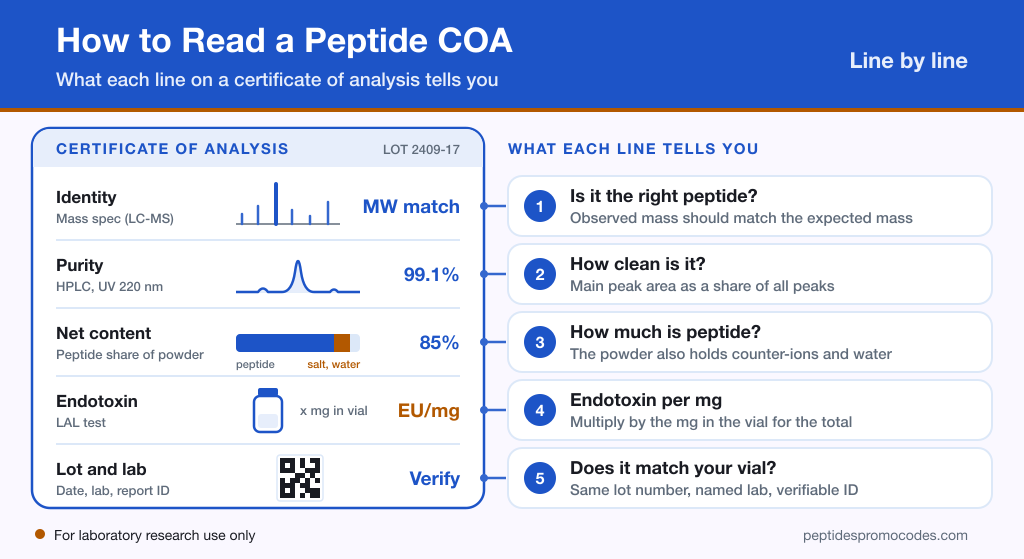
A certificate of analysis (COA) is the lab report behind a peptide’s purity claim. Knowing how to read a peptide COA tells you whether that report proves anything about the vial in front of you. This guide walks through each line in order.
The short answer: read a peptide COA from the top down. Match the lot number and test date to your vial. Check that mass spectrometry found the right molecular weight. Then read the HPLC purity, the net peptide content or measured quantity, and the endotoxin result. Finally, confirm who ran the tests and whether you can verify the report.
What Is a Peptide Certificate of Analysis?
A peptide certificate of analysis is the lab report for one batch (or lot), meaning one production run. A complete report answers four questions:
- Identity: is this the peptide on the label?
- Purity: how much of the peptide material is the target peptide?
- Quantity: how much peptide is in the vial?
- Contaminants: did the batch pass tests such as endotoxin?
A bare purity figure answers only one of these. That is why our buyer’s guide asks for the full report.
How to Read a Peptide COA: Start With the Header
Read the header before the purity number. It tells you whether the rest of the report applies to you.
- Lot number: it should match the code on your vial. If it doesn’t, the report describes another batch.
- Dates: the sample should arrive before it is tested. A report from years ago says little about stock on sale today.
- Lab name: an in-house report comes from the seller’s own lab. A third-party report comes from an independent lab with no stake in the result.
Some labs add a report ID or QR code that opens the original record on the lab’s own website. Some vendors offer a similar lookup: Peptide Confidential, for example, prints a code on the vial label that finds that batch’s record and original report. If you can verify a report, do it every time.
Identity: Is It the Right Peptide?
Identity is usually confirmed by mass spectrometry (MS), often written LC-MS when paired with liquid chromatography. MS weighs molecules by turning them into charged particles.
The report lists an expected molecular weight, worked out from the sequence, and an observed one. They should agree closely. A large gap means the main compound is something else.
One detail confuses first-time readers. MS measures mass divided by charge (m/z), so a peptide carrying two charges shows up at about half its mass. Check whether the report shows that raw value or the converted full mass.
This test catches a mislabelled vial. A common question in peptide research communities is about a vial that tested as a completely different peptide. Purity alone would not flag that, because a different compound can still show one clean peak.
What Does 99% Purity Mean on a Peptide COA?
Purity is usually measured by high-performance liquid chromatography (HPLC). Some reports say UPLC, a higher-pressure form of the same technique. The sample runs through a column, and compounds come out at different times. A UV detector, usually set at 210 to 220 nm, records each one as a peak.
Purity is the main peak’s area as a share of the total peak area. So 99% purity means 99% of what the detector saw was in the main peak. The other 1% is mostly by-products of synthesis, such as:
- Deletion sequences: chains missing one or more amino acids.
- Truncated sequences: chains that stopped short.
- Insertion sequences: chains with an extra copy of an amino acid.
- Diastereomers: the right sequence with one amino acid in its mirror-image form.
- Modified forms: side chains changed during synthesis or storage.
Purity does not count water or salts, as the next section explains.
HPLC purity vs mass spec: why you need both
HPLC only counts what it separates. An impurity that comes off the column with the main peak hides inside it. This is called co-elution, and diastereomers are especially hard to separate this way.
Mass spec can reveal a hidden impurity when its mass differs. In one study of synthetic glucagon, two impurities, each missing one amino acid, co-eluted in HPLC. The researchers used high-resolution mass spectrometry to identify and measure them. That is why purity without an identity test is incomplete.
Reading the chromatogram
The chromatogram is the graph behind the purity number. Time runs along the bottom, and peaks rise where compounds come out. A clean result shows one tall, sharp main peak and a few small ones.
Retention time is how long a compound takes to come out. Labs can match it to a reference standard of the same peptide as an identity check. Be wary of a main peak with a shoulder or split top, which can mean something is co-eluting. Be wary too of a purity figure with no chromatogram at all.
Peptide Content vs Purity: Why a “10 mg” Vial Can Hold Less Peptide
Purity tells you how clean the peptide material is. It does not tell you how much of the powder is peptide.
Gross weight is everything in the vial: the peptide, its counter-ions and absorbed water. Counter-ions are small acid molecules, usually trifluoroacetate (TFA) or acetate, bound to the peptide’s charged groups. Net peptide content (NPC) is the peptide’s share of that total.
Bachem puts the content of research peptides at 70 to 90%, even when HPLC purity is above 95%. Its formula is simple:
Net weight = gross weight x NPC / 100
At 85% NPC, 10 mg of powder holds 8.5 mg of peptide. So a vial with 10 mg of powder can honestly hold less than 10 mg of peptide. One peptide maker’s FAQ says an order for 1 mg means 1 mg of freeze-dried powder by industry standard. Ask your seller which weight the label means.
Labs measure content by nitrogen analysis (counter-ions and water contain no nitrogen) or amino acid analysis. Some reports give a measured quantity instead, such as 49.4 mg in a vial labelled 50 mg. Labs can measure this by HPLC against a reference standard. Ask whether that figure is peptide alone or total powder.
Use the measured amount, not the label, in our Peptide Reconstitution Calculator, and see our guide to converting peptide units to mg for the math.
What Does Endotoxin EU/mg Mean on a COA?
Endotoxins are lipopolysaccharides from the outer membrane of gram-negative bacteria. They are measured with the bacterial endotoxins test, often called the LAL test. LAL is an extract of horseshoe crab blood cells that reacts to endotoxin. Results come in endotoxin units (EU), a measure of endotoxin activity, often per mg of material.
Three tips for reading the number:
- Scale it to the vial. Total endotoxin is the EU/mg figure times the milligrams in the vial. At the same EU/mg, a 500 mg vial holds 50 times as much as a 10 mg vial.
- Read the less-than sign. A “<” result means the test found less than that amount. It doesn’t mean zero.
- Know the limit depends on use. For regulated drugs, the limit is calculated from the maximum dose and the route. There is no single “good” number.
For research material, the right cut-off depends on what your experiment can tolerate.
Heavy Metals and Sterility Results
Some reports add extra tests. Each covers only what it names.
- Heavy metals: tests for elements such as lead, mercury, arsenic and cadmium, usually by ICP-MS or ICP-OES.
- Sterility: a test such as USP <71> places a sample in growth media and watches for microbes for at least 14 days.
What Each COA Line Tells You, and What It Doesn’t
| COA line | What it tells you | What it doesn’t tell you |
|---|---|---|
| Lot number | Which batch was tested | Whether your vial came from it |
| Test date | When the sample was tested | How the batch has held up since |
| Lab name | Who ran the tests | Whether the report is genuine |
| Mass spec (MS) | The main compound’s molecular weight is right | How pure the sample is |
| HPLC purity | Share of detected material in the main peak | Water, salts or hidden co-eluting impurities |
| Chromatogram | How clean the separation looked | What each small peak is |
| Net content or quantity | How much peptide is in the vial | How pure that peptide is |
| Endotoxin (EU/mg) | Endotoxin in the tested sample | Whether that level suits your use |
| Heavy metals, sterility | Results for the named tests | Anything that wasn’t tested |
Red Flags on a Peptide COA
Run through this checklist before you trust a report:
- No lot or batch number.
- No testing lab named, or a lab you can’t find.
- Dates that don’t line up.
- The same report, chromatogram or numbers across different products.
- Fonts, spacing or blurred fields that look edited.
- Purity only, with no identity test.
- An observed molecular weight that doesn’t match the peptide.
- A report for a different lot than the one on your vial.
- No way to verify the report with the lab.
One of these is a reason to ask the seller questions. Several are a reason to walk away. Our guide to peptide scams covers the wider warning signs.
Does a Batch COA Prove What Is in Your Vial?
No. A batch COA tests a sample from that batch on one date. Your vial may have been filled, stored or shipped differently, and peptides can degrade in storage. A matching, verifiable report is good evidence, but it is not a test of your vial.
Independent testing of your own vial makes sense when:
- The seller has no batch report, or it doesn’t match your lot.
- The vial or powder looks different from what you expected.
- Your research depends on exact identity, amount or endotoxin level.
- You are using a new source for the first time.
Our guide to peptide testing labs explains which tests to order.
Research peptides are sold for laboratory research use only. They are not for human or veterinary use.
Frequently Asked Questions
What is a good purity on a peptide COA?
Research peptides are typically above 95% pure by HPLC, and many sellers list 98 to 99%. The number means little without an identity test and a lot number that matches your vial.
What is the other 1% in a 99% pure peptide?
It is mostly related peptides made during synthesis, such as chains missing an amino acid or cut short. Water and counter-ions are not part of this figure.
Is HPLC purity the same as net peptide content?
No. Purity is the share of the peptide material that is the target peptide. Net peptide content is the share of the powder’s weight that is peptide at all.
How can I tell if a peptide COA is fake?
Check for a matching lot number, a named lab, sensible dates and an identity test. Look for reused layouts or edited fields. The strongest check is verifying the report ID with the lab that issued it.
What endotoxin level is acceptable?
It depends on the intended use. Limits for regulated drugs are calculated from dose and route, so no single number applies. For research, compare the result with what your experiment can tolerate.
Compare suppliers that publish batch reports in our directory, read the buyer’s guide before you order, and run your measured peptide amount through the Peptide Reconstitution Calculator.
Sources
- Bachem: FAQ: definitions of gross weight, net peptide content and HPLC purity measured at 220 nm.
- Bachem: Care and Handling of Peptides: why peptide content is 70 to 90% of the solid, due to counter-ions and moisture.
- USP Therapeutic Peptides Expert Panel: Control Strategies for Synthetic Therapeutic Peptide APIs, Part III: the main types of peptide-related impurities and how each is detected.
- McCarthy et al., Reference Standards to Support Quality of Synthetic Peptide Therapeutics (Pharmaceutical Research, 2023): HPLC identity by retention time, content assays and mass spectrometry.
- Kodidasu et al., Absolute Quantitation of Coeluting Impurities in Peptide Drugs Using High Resolution Mass Spectrometry (J Am Soc Mass Spectrom, 2025): co-eluting glucagon impurities measured by LC-HRMS.
- FDA: Bacterial Endotoxins/Pyrogens: what endotoxins are, the LAL test, endotoxin units and dose-based limits.