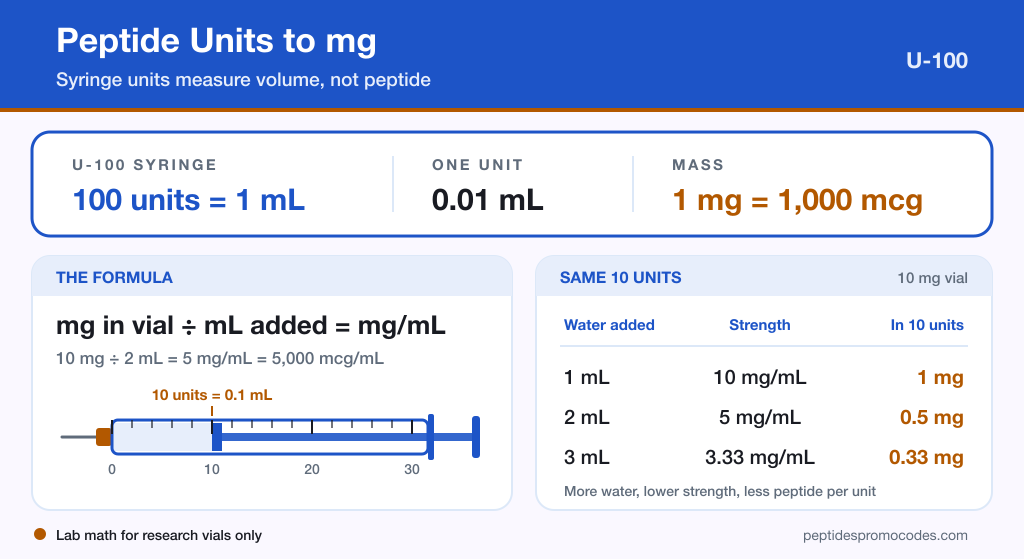
“How many units is that?” is one of the most common questions in peptide research communities. The trouble is that a unit is not an amount of peptide. It is a line on a syringe. This guide shows you how to convert peptide units to mg and mcg with one formula and a few worked examples.
To convert peptide units to mg, you first need the concentration. Divide the mg of peptide in the vial by the mL of liquid you added. On a U-100 insulin syringe, 100 units equal 1 mL, so 1 unit is 0.01 mL. Multiply the units by 0.01 to get mL, then multiply by the concentration.
Research peptides are sold for laboratory research use only, not for human or veterinary use. Every number in this guide is bench arithmetic for a research vial.
What Does a Unit on an Insulin Syringe Measure?
U-100 insulin contains 100 units of insulin in every mL, and a U-100 syringe is marked to match. Take the insulin away and what is left is a plain volume scale:
- 100 units = 1 mL
- 10 units = 0.1 mL
- 1 unit = 0.01 mL
Barrels come in different sizes. A 1 mL syringe reads up to 100 units, a 0.5 mL syringe up to 50 units, and a 0.3 mL syringe up to 30 units. A unit is the same volume on all three. Some 0.3 mL barrels also carry half-unit marks for small readings.
Why a syringe unit is not a dose
A unit tells you how much liquid is in the barrel, not how much peptide that liquid holds. That depends on how the vial was mixed. Ten units from one vial can hold three times as much peptide as ten units from another.
So “how many units of X?” has no single answer. A common piece of advice in peptide research communities is to stop measuring in units and think in mg or mcg.
Units vs mL vs mg vs mcg: What Is the Difference?
Units and mL measure volume (how much liquid). Mg and mcg measure mass (how much peptide).
| Term | What it measures | Conversion |
|---|---|---|
| Unit (U-100 syringe) | Volume | 1 unit = 0.01 mL |
| mL (milliliter) | Volume | 1 mL = 100 units |
| mg (milligram) | Mass of peptide | 1 mg = 1,000 mcg |
| mcg (microgram) | Mass of peptide | 1 mcg = 0.001 mg |
Small amounts are easier to write in mcg: 0.25 mg is 250 mcg. What links volume to mass is concentration.
How to Calculate Peptide Concentration (mg/mL)
Concentration is how much peptide sits in each mL of liquid. You need two numbers: the mg of peptide in the vial and the mL of diluent you added.
A diluent is the liquid you use to dissolve the powder. Bacteriostatic water is one example: sterile water with benzyl alcohol added as a preservative. Our guide to bacteriostatic water for peptides covers it in more detail.
The three formulas:
- Concentration (mg/mL) = peptide in the vial (mg) ÷ diluent added (mL)
- Concentration (mcg/mL) = mg/mL × 1,000
- Peptide per unit (mcg) = mcg/mL ÷ 100
The last one works because 1 unit is one hundredth of a mL. Like our calculator, this math treats the final volume as the volume of liquid you added.
Worked example: a 10 mg vial with 2 mL
- Find the concentration: 10 mg ÷ 2 mL = 5 mg/mL.
- Convert to mcg: 5 mg/mL × 1,000 = 5,000 mcg/mL.
- Find the peptide per unit: 5,000 ÷ 100 = 50 mcg per unit.
- Convert 10 units: 10 units is 0.1 mL, and 0.1 mL × 5 mg/mL = 0.5 mg, or 500 mcg.
So on a U-100 syringe, 10 units drawn from this vial hold 0.5 mg of peptide.
Peptide Reconstitution Math: Same 10 Units, Different Amounts
Reconstitution means adding liquid to a freeze-dried powder to turn it back into a solution. The volume you add changes the concentration. It does not change the total amount of peptide in the vial.
Here is the same 10 mg vial mixed three ways. In every row you draw the same 10 units (0.1 mL).
| Diluent added | Concentration | Peptide per unit (0.01 mL) | Peptide in 10 units (0.1 mL) |
|---|---|---|---|
| 1 mL | 10 mg/mL (10,000 mcg/mL) | 100 mcg | 1 mg (1,000 mcg) |
| 2 mL | 5 mg/mL (5,000 mcg/mL) | 50 mcg | 0.5 mg (500 mcg) |
| 3 mL | about 3.33 mg/mL (3,333 mcg/mL) | about 33.3 mcg | about 0.33 mg (333 mcg) |
Same syringe, same line, three different amounts. More liquid spreads the same 10 mg further, so each unit holds less.
Vial size matters just as much. A 5 mg vial mixed with 2 mL gives 2.5 mg/mL, so 10 units hold 0.25 mg (250 mcg), half the 10 mg vial’s amount.
At 3 mL the concentration never ends (3.333…). Round it once and write it on the vial.
How to Convert mcg to Units
Sometimes you know the amount of peptide you want and need the syringe mark. Two steps:
- Find the volume: mL = mcg wanted ÷ concentration in mcg/mL.
- Convert to units: units = mL × 100.
Or in one step: units = mcg wanted ÷ mcg per unit.
Say the 10 mg vial was mixed with 2 mL, so it holds 50 mcg per unit. To measure out 250 mcg for a lab assay (a test run on the sample), you need 250 ÷ 50 = 5 units, or 0.05 mL.
Mix the same vial with 3 mL instead. Now 250 mcg needs 0.075 mL, which is 7.5 units. That half-unit reading is where a 0.3 mL barrel with half-unit marks helps.
Let the calculator do the math
The Peptide Reconstitution Calculator runs these steps for you. Enter the peptide in the vial (mg or mcg), the bacteriostatic water you added and the amount you want to measure, then pick a 1 mL, 0.5 mL or 0.3 mL U-100 syringe. It returns the concentration, the peptide per unit, the volume to draw and the mark to read. It also warns you when a reading falls under 5 units, where small errors matter more.
Common Mistakes When Converting Peptide Units to mg
Mixing up mg and mcg
One mg is 1,000 mcg. Swap them and you are off by a factor of 1,000. The FDA warns that “mcg” and “µg” can be misread as “mg”, which creates exactly that 1,000-fold error. Write the unit clearly next to every number.
Trusting the label amount without checking
Your math starts with the number on the vial. If that number is wrong, so is every result.
In a 2024 study in the Journal of Medical Internet Research, researchers tested three semaglutide vials bought online without a prescription. The measured content was 28.56% to 38.69% higher than the labels claimed.
A certificate of analysis (COA), a lab report on a batch, is one way to check. Learn how to read a peptide COA and what third-party testing labs check for.
Using a U-40 syringe instead of U-100
Not every insulin syringe is U-100. U-40 syringes are veterinary syringes made for U-40 insulin. On a U-40 syringe, 1 unit is 0.025 mL, not 0.01 mL.
So 10 units on a U-40 barrel is 0.25 mL. That is 2.5 times the volume of 10 units on a U-100 barrel. From a 5 mg/mL vial, it holds 1.25 mg instead of 0.5 mg.
In one published case report, the U-40 syringe had a red cap and red scale, while the U-100 syringe had an orange cap and black scale. Don’t rely on color alone. Check that the syringe is marked U-100, because the calculator and every example here assume it.
Forgetting how much diluent you added
If you don’t know the volume, you can’t know the concentration. Write the volume on the label the moment you add it.
Dropping a zero or a decimal point
FDA guidance on avoiding medication errors says to use a leading zero and skip trailing zeros.
- Write 0.5 mg, not “.5 mg”, which can be read as 5 mg.
- Write 5 mg, not “5.0 mg”, which can be read as 50 mg.
- Write units in full. The FDA notes that a “U” written after a number can be misread as a zero.
How to Label a Vial With Its Concentration
A clear label saves you from redoing the math later. Put these on every reconstituted vial:
- Peptide name and lot number: so you can match the vial to its COA.
- Amount in the vial: as labeled, such as 10 mg.
- Diluent and volume: such as 2 mL bacteriostatic water.
- Concentration in both forms: such as 5 mg/mL = 5,000 mcg/mL.
- Peptide per U-100 unit: such as 50 mcg per unit.
- Date mixed and your initials.
A finished label for the example vial might read:
10 mg + 2 mL BAC water = 5 mg/mL (5,000 mcg/mL), 50 mcg per unit, mixed 24 Sep 2026
If the powder won’t dissolve or the solution looks cloudy after mixing, see our guide to peptide reconstitution problems.
Frequently Asked Questions
How many mL is 10 units on an insulin syringe?
On a U-100 insulin syringe, 10 units is 0.1 mL, because 100 units equal 1 mL. On a U-40 syringe, 10 units is 0.25 mL.
How many mg of peptide are in 10 units?
It depends on the concentration. For a 10 mg vial mixed with 2 mL, 10 units hold 0.5 mg. Mix the same vial with 1 mL and 10 units hold 1 mg.
How do I calculate peptide concentration?
Divide the mg of peptide in the vial by the mL of diluent you added. Multiply the result by 1,000 to get mcg/mL. Divide mcg/mL by 100 to get the mcg in one U-100 unit.
Does adding more bacteriostatic water change the amount of peptide?
No. The vial holds the same total amount whatever volume you add. More water lowers the concentration, so each unit holds less peptide.
How do I convert mcg to units?
Divide the mcg you want by the mcg in one unit. At 50 mcg per unit, 250 mcg is 5 units.
Run your own numbers in the Peptide Reconstitution Calculator. Before you order a vial, our buyer’s guide covers what to check, and the supplier directory lists the stores we track.
Sources
- DailyMed: Humulin R (insulin human) label: states that U-100 insulin contains 100 units per mL and should be used with a syringe marked for U-100.
- embecta: Ultra-Fine insulin syringes: syringe capacities of 1 mL, 0.5 mL and 0.3 mL, with half-unit marks available on the 0.3 mL barrel.
- Case Reports in Endocrinology (PMC): Poorly Controlled Type 3c Diabetes due to Use of Veterinarian Insulin Syringes: unit volumes on U-40 and U-100 syringes and how their caps and scales differ.
- FDA: A Microgram of Prevention is Worth a Milligram of Cure: mcg and mg mix-ups, the “U” abbreviation, and leading and trailing zeros.
- Journal of Medical Internet Research (PMC): Multifactor Quality and Safety Analysis of Semaglutide Products Sold by Online Sellers Without a Prescription: measured content compared with labeled amounts in test purchases.
- DailyMed: Bacteriostatic Water for Injection label: what bacteriostatic water contains.