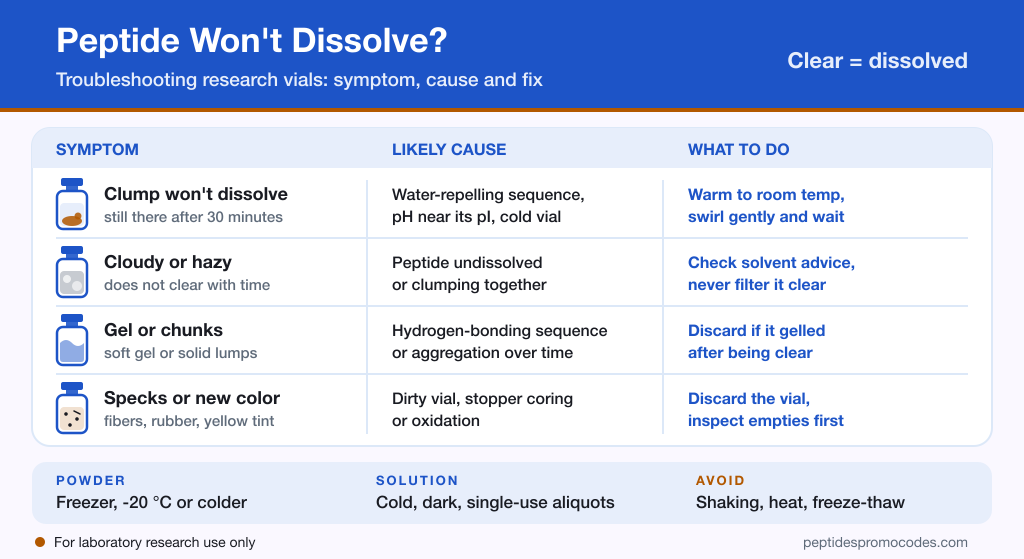
You add bacteriostatic water, roll the vial for half an hour, and a clump still sits at the bottom. If your peptide won’t dissolve, or it turned cloudy, gelled or grew specks, you are not alone. It is one of the most common questions in peptide research communities. This guide covers the causes, the fixes, and when a vial belongs in the bin.
Short answer: most peptides that won’t dissolve have a water-repelling (hydrophobic) sequence, carry little charge at the liquid’s pH, or were mixed too fast from a cold vial. Let the vial reach room temperature, run the liquid down the glass wall, swirl gently and wait. If it stays cloudy or gels, the sequence may need a different solvent.
Peptide Won’t Dissolve? Why It Happens
Research peptides usually arrive lyophilized, which means freeze-dried into a dry powder or “cake”. Adding liquid to turn it back into a solution is called reconstitution. GenScript’s solubility guide says peptides shorter than six amino acids generally dissolve in plain water. For longer chains, it depends on charge and hydrophobicity.
Hydrophobic sequences
Hydrophobic means water-repelling. Thermo Fisher’s peptide design guide says peptides with 50% or more hydrophobic residues may be insoluble or only partly soluble. Peptides with more than 25% charged residues and less than 25% hydrophobic ones usually dissolve.
Charge and the isoelectric point
Charged amino acids help a peptide mix with water. Every peptide also has an isoelectric point (pI): the pH at which its positive and negative charges cancel out. Near that pH, the molecules have little charge to push each other apart. Chemists improve solubility by keeping the solution’s pH away from the pI.
A cold vial or a rushed mix
Thermo Fisher tells users to let a peptide warm to room temperature before dissolving it. Bachem says to let a cold container reach room temperature before opening it, because peptides absorb moisture from the air.
Shaking hard makes foam. A 2022 review in Pharmaceutics explains that agitation increases the air and water surface, which speeds up aggregation. Aggregation means peptide molecules sticking together into clumps.
How Do You Dissolve a Stubborn Peptide Gently?
- Warm it up first. Take the vial out of cold storage and let it reach room temperature before you pierce it.
- Check the paperwork. Some suppliers list a recommended solvent. GenScript, for example, prints one on its certificate of analysis. See how to read a peptide COA.
- Aim for the glass. Add the diluent slowly and let it run down the inside wall of the vial. Standard instructions for freeze-dried vials do this to avoid excess foaming.
- Swirl or roll, don’t shake. Qkine’s reconstitution sheet says not to vortex and to avoid foaming.
- Give it time. Let the vial stand for several minutes, then swirl and look again.
- Lab options. Bachem suggests a few minutes in a sonicating water bath (a bath that agitates liquid with sound waves). Thermo Fisher allows careful warming, but not above 40 °C.
Once it is clear, use the Peptide Reconstitution Calculator to work out the concentration. If the diluent is in doubt, our bacteriostatic water guide covers it.
When Does a Peptide Need a Different Solvent?
Some sequences never dissolve well in plain or bacteriostatic water. Supplier guides pick a solvent by net charge:
- Basic peptides (net positive charge): if water fails, GenScript suggests a 10% to 30% acetic acid solution.
- Acidic peptides (net negative charge): a small amount of dilute ammonium hydroxide, then dilution. GenScript says not to use it on peptides that contain cysteine.
- Very hydrophobic or neutral peptides: a small amount of an organic solvent such as DMSO, then slow dilution with water.
Bachem, GenScript and Thermo Fisher all give the same first step: test a small portion before you dissolve the whole sample. With research vials, you usually wet the whole cake at once, so read the supplier’s advice first.
Solvent choice is a bench decision. Research peptides are for laboratory research use only, not for human or veterinary use.
What Does a Cloudy Peptide After Reconstitution Mean?
A fully dissolved peptide looks clear. AltaBioscience’s handling guide says cloudiness or visible particles mean the peptide is still suspended, not dissolved. The Pharmaceutics review also lists turbidity (haze) as a visual sign of aggregation.
Tiny bubbles from mixing can look hazy at first. Let the vial stand so any foam settles, then look again.
Many people blame the bacteriostatic water. The FAQ below has a simple way to check.
Peptide turned to gel or chunks
Some sequences gel in water by nature. Thermo Fisher notes that some peptides are more than 75% polar amino acids (D, E, H, K, N, Q, R, S, T or Y). These can form hydrogen bonds between molecules and set into a gel. Its suggested fixes are an organic solvent or a change in buffer pH.
A vial that was clear and later turned to gel or chunks is different. Treat it as failed, because you can no longer trust its concentration.
Particles, fibers or specks
Anything in an empty vial will still be there after you add liquid. Hold empty vials up to the light and reject any with fibers or specks.
Stoppers are another source. “Coring” is when a needle shears a small piece of rubber off the stopper and pushes it into the vial. A 2025 review in the Journal of VitreoRetinal Diseases links it to larger needles, straight-on punctures, repeated punctures and thick stoppers.
Color changes
Cysteine, methionine and tryptophan oxidize easily, and AltaBioscience links oxidation to discoloration. Unless the product is meant to have a color, a new tint is a warning sign.
When to discard a vial
- It stays cloudy after time and gentle swirling.
- It turned to gel or chunks after being clear.
- You see fibers, specks or rubber pieces.
- The color changed.
- You are not sure it stayed sterile.
Should You Use a 0.22 Micron Filter for Peptides?
A 0.22 µm (micron) syringe filter has pores small enough to hold back bacteria. GenScript recommends passing peptide solutions through a 0.2 µm membrane to remove bacterial contamination before storage. It only helps if the filtered liquid goes into a sterile container.
Membrane type matters. MilliporeSigma markets PES (polyethersulfone) membranes as low protein binding and its PVDF (polyvinylidene fluoride) membrane as its lowest binding option. Some material is still lost in the filter housing. A 2020 study (of mold toxins, not peptides) found that losses to the membrane can be large and depend on the membrane and molecule.
Two limits to keep in mind:
- Don’t filter a cloudy vial to “fix” it. The filter traps undissolved peptide, so the concentration drops below what you calculated.
- A filter removes bacteria, not doubt. It won’t repair a degraded or mislabeled peptide. For that, see our guide to third-party peptide testing labs.
How Do You Store Lyophilized and Reconstituted Peptides?
Lyophilized peptide storage
Dry powder is the most stable form. GenScript says most lyophilized peptides stay stable for several years at -20 °C, away from bright light. Bachem recommends below -15 °C, and colder (such as -50 °C) for long-term storage.
Short trips are fine. Bachem says even sensitive peptides can ship at room temperature and sit in a fridge at 4 °C for short-term use. Keep vials sealed and dry.
How to store reconstituted peptides
- Use solutions promptly. Thermo Fisher says peptide solutions are unstable, and the lower the concentration, the less stable they are.
- Freeze in portions if you must store. GenScript does not recommend storing peptides in solution. If you must, it suggests sterile buffer at pH 5 to 6, aliquots (single-use portions) and freezing.
- Avoid repeated freeze-thaw cycles. Thermo Fisher and GenScript both say this.
- Keep them dark. Thermo Fisher says many peptides are light-sensitive.
- Know the fragile ones. Bachem says peptides containing Asn, Gln, Cys, Met or Trp have shorter lives in solution.
Can reconstituted peptides be left out overnight?
There is no single answer. Stability depends on the sequence, concentration and temperature, and we found no general safe number of hours. Heat speeds up breakdown, and solutions are fragile even when cold. Log the excursion, and test the vial if your results depend on it. If it also looks cloudy or discolored, discard it.
Quick Troubleshooting Table
| Symptom | Likely cause | What to do |
|---|---|---|
| Clump after 30 minutes | Hydrophobic sequence, pH near pI, cold vial | Warm to room temperature, swirl gently, wait |
| Stays cloudy | Undissolved or aggregated peptide | Check solvent advice; don’t filter it clear |
| Gel in fresh solution | Hydrogen-bonding sequence | Follow supplier solubility advice |
| Clear vial later gels or chunks | Aggregation over time | Discard |
| Fibers or specks | Dirty vial or stopper coring | Discard; inspect empty vials first |
| New yellow or brown tint | Possible oxidation | Discard |
| Left at room temperature | Unknown loss, varies by peptide | Log it; test if results depend on it |
Frequently Asked Questions
Why is my peptide still a clump after 30 minutes?
The sequence may be hydrophobic or near its isoelectric point, or the vial was cold. Let it stand at room temperature and swirl gently every few minutes. If nothing changes, it may need a different solvent.
Can you use a cloudy peptide after reconstitution?
Not with confidence. Cloudiness means some peptide is undissolved or aggregated, so the real concentration is unknown. Discard it if it stays cloudy.
Does bacteriostatic water make peptides cloudy?
Test it rather than guess. Put a little of the same water in a clean vial. If it is clear on its own, the cloudiness comes from the peptide in that liquid.
Should you filter every vial with a 0.22 micron filter?
A 0.22 µm filter removes bacteria, which is why GenScript recommends one before storing solutions. It will not fix cloudiness, and some peptide stays in the filter.
Is a mini fridge good enough for peptide storage?
For short-term storage, yes, if it holds a steady temperature around 4 °C. Check it with a thermometer. For long-term storage of lyophilized powder, supplier guides recommend a freezer at -20 °C or colder.
Work out your concentration with the Peptide Reconstitution Calculator and see how units relate to mg/mL. Before you order, our buyer’s guide covers what to check, and the supplier directory lists the stores we track.
Sources
- Bachem: Handling and Storage Guidelines for Peptides: storage temperatures, moisture, sonication and solution storage.
- Thermo Fisher Scientific: Handling and Storage Instructions, Standard Peptides (PDF): warming before dissolving, solvents, light and freeze-thaw cycles.
- Thermo Fisher Scientific: Peptide Design: hydrophobic content, charged residues and gel formation.
- GenScript: Peptide Solubility Guidelines (PDF): choosing a solvent by net charge, including dilute acetic acid.
- GenScript: Peptide Storage and Handling Guidelines: lyophilized storage, solutions and 0.2 µm filtration.
- Akbarian and Chen (2022), Instability Challenges and Stabilization Strategies of Pharmaceutical Proteins, Pharmaceutics: agitation, temperature, light, oxidation and turbidity as a sign of aggregation.