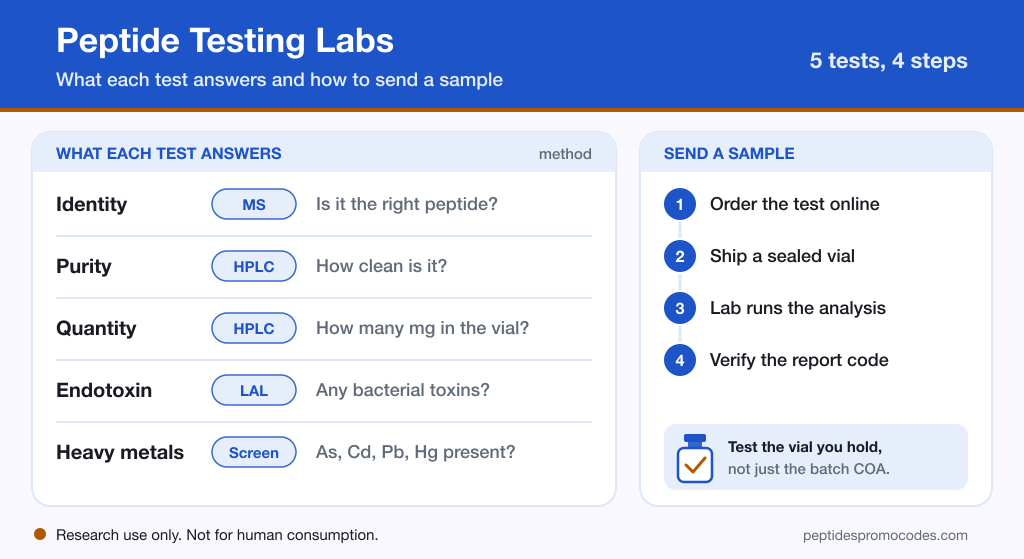
You bought a vial with a label, and maybe a certificate. A peptide testing lab can tell you whether the contents match. This guide explains what each test answers and how to use a lab well.
The short answer: a peptide testing lab analyses a sealed vial you send in and reports what is inside. The core test covers identity (is it the right peptide?), purity (how clean is it?) and quantity (how many mg are in the vial?). Endotoxin, heavy metal and sterility tests are optional add-ons. Many labs let you verify the report online.
Research peptides are sold for laboratory research use only. They are not for human or veterinary use.
Why Test Your Own Vial if the Vendor Has a COA?
A certificate of analysis (COA) is a lab report on a sample. A vendor’s COA usually covers one batch, tested before it reached you. It does not prove what is in the vial on your bench.
Things can go wrong after that test:
- Mislabels: the wrong label goes on a vial, or on a whole batch.
- Mix-ups: two products get swapped during packing.
- Counterfeits: a copied label, or a real COA reused for a different product.
- Degradation: peptides can break down, and the breakdown products show up as impurities.
Buyers in peptide research communities have shared results where a vial labelled as one GLP-1 compound held a different one. A whole batch had been labelled wrong. Only a test of the vial itself caught it. That is why people talk about “testing at the end of the supply chain.”
Some vendors now publish a third-party report for every batch. Peptide Confidential, for example, lets you look up a batch report with the code on the vial label. That is worth checking, but it still describes the batch. Testing your own vial is the strongest check you have. For other warning signs, see our guide to peptide scams.
What Can a Peptide Testing Lab Check?
Each test answers a different question:
| Test | Question it answers | Common method |
|---|---|---|
| Identity | Is this the peptide on the label? | Mass spectrometry, or HPLC against a reference standard |
| Purity | How much of the peptide material is the target peptide? | HPLC with UV detection |
| Quantity | How many mg of peptide are in the vial? | HPLC against a reference standard |
| Endotoxin | Are bacterial toxins present, and how much? | LAL test |
| Heavy metals | Is there arsenic, cadmium, lead or mercury? | Elemental screening, such as X-ray fluorescence |
| Sterility | Are live bacteria, yeast or mold present? | Culture tests on unopened vials |
Identity: the peptide mass spec test
Mass spectrometry (mass spec, or MS) measures the mass of molecules. Every peptide has a known molecular weight, so a matching mass is strong evidence you have the right one. Some methods also confirm the amino acid sequence. Labs often pair it with liquid chromatography, shown as LC-MS on a report. Other labs confirm identity with HPLC, by comparing your sample with a reference standard.
Purity by HPLC
HPLC (high-performance liquid chromatography) separates a sample into its parts. Each part shows up as a peak on a chart, read with UV light at about 210 to 220 nm. Purity is the main peak’s share of the total peak area.
Quantity and net peptide content
Quantity tells you how many mg of peptide are really in the vial. This is not the same as purity. A peptide powder also holds water and counterions (salts left over from manufacturing, such as TFA or acetate). So a vial can show high purity and still hold less peptide than the label says. That changes your concentration math, as our guide to peptide units and mg explains.
Peptide endotoxin testing
Endotoxins are molecules from the outer membrane of gram-negative bacteria. They are not live bacteria, so they are a separate question from sterility. The standard method is the LAL (Limulus amebocyte lysate) test. It uses horseshoe crab blood cells, which clot when they meet endotoxin. The US FDA has accepted LAL testing for endotoxins for more than 30 years. Results are given in endotoxin units (EU).
Heavy metals
A heavy metals screen usually checks for arsenic, cadmium, lead and mercury. Janoshik, for example, runs this screen with X-ray fluorescence.
Sterility
A sterility test grows the sample in culture to see if live bacteria, yeast or mold are present. It needs unopened vials, because opening a vial can contaminate it. It is also slow: Janoshik lists an average of 14 days for its version.
Which Tests Should You Prioritise?
Start with the core test, then add others as needed:
- Identity, purity and quantity first. Many labs sell these as one core test. It catches mislabels, swaps and underfilled vials.
- Endotoxin next, if your research needs to rule out bacterial contamination. The core test does not cover it.
- Heavy metals when you try a new source or know little about the maker.
- Sterility when you need it and can spare extra unopened vials and time.
Good times to test: a new vendor, a new batch, or a label that doesn’t match the paperwork. If a vial behaves oddly, our guide to reconstitution problems covers common causes first.
How to Get Peptides Tested: Step by Step
The details differ by lab, but the usual process is:
- Order the test online. Pick the peptide and any add-ons, then pay.
- Ship a sealed vial. You get shipping instructions after you order. Janoshik asks for at least one whole unopened vial for a standard peptide test, and extra vials for some add-ons.
- The lab runs the analysis. Turnaround varies. Peptide Test Canada states 5 to 7 business days after your sample arrives. Janoshik lists an average on each test page, such as 5 days for its BPC-157 test.
- Get and verify the report. It arrives by email or in your account. Check it on the lab’s own site with its code or QR code.
Before you ship, photograph the vial and label, and write down the lot number. Keep a second vial from the same batch if you can.
How Do You Judge a Peptide Testing Lab?
Check these points before you pay:
- Accreditation. ISO/IEC 17025 is the international standard for the competence, impartiality and consistent operation of testing labs. It covers only the methods listed in the lab’s scope of accreditation, so check your test is on it. Not every lab that serves peptide buyers holds it, so ask.
- Method disclosure. The report should name the method (HPLC, LC-MS, LAL). Raw data, such as the chromatogram, is a plus.
- Report verification. A code, QR code or public database lets anyone confirm a report is real and unedited.
- Published prices and turnaround. You should know the cost and timeline before you ship.
- Test menu. The lab should list your peptide and say what each test includes.
Independent Peptide Testing Labs Buyers Mention
These labs come up often in peptide research communities. This is not a ranking or an endorsement, and services and prices change.
- Janoshik: based in Prague, Czech Republic, and accepts samples worldwide. It lists tests and prices in an online shop, including a blind GLP-1 test covering semaglutide, tirzepatide and retatrutide. Add-ons include endotoxin, heavy metals, sterility and LC-MS screening for other peptides. Reports can be checked on its Verify page or by QR code.
- Finnrick: a testing service that sends samples to partner labs it names on its site. It offers free community testing with public results, plus paid tiers with confidential results. Add-ons include endotoxins, heavy metals and residual solvents. Its site says testing is available to US residents only.
- Peptide Test Canada: a lab in Mississauga, Ontario. Its standard report covers HPLC purity and mass spec identity, with heavy metals and LAL endotoxin testing as add-ons. Each report includes a QR verification code.
Can You Split the Cost With Group Testing?
Testing costs add up. One answer is group testing, or pooling: several buyers with vials from the same batch share the cost of testing one vial.
It works best when every vial shares one lot number, and one person ships a sealed vial and shares the report’s verification code. One vial stands for the batch, not every vial in it.
Janoshik takes group orders through its contact form rather than its web shop. Finnrick says its free tier is for individuals only, and testing for others goes through its professional services. Check a lab’s rules before you split a bill.
How Do You Read Your Test Results?
Read the report in this order:
- Match the sample. The report should describe your vial: its name, label claim and lot.
- Identity first. If the lab found a different compound, the other numbers don’t matter. Set the vial aside and contact the vendor.
- Purity and quantity separately. High purity with a low mg figure means clean peptide, but less of it than the label says.
- Endotoxin units. Note the EU value and the test’s range. Janoshik, for example, says its standard endotoxin test is accurate up to 10 EU per vial.
- Verify it. Check the report on the lab’s site, not just the PDF.
If the measured mg differs from the label, use the real figure in the Peptide Reconstitution Calculator. For a line-by-line walkthrough, see how to read a peptide COA.
Frequently Asked Questions
How much does third party peptide testing cost?
It depends on the lab, the peptide and the add-ons. Endotoxin, heavy metal and sterility tests usually cost extra. Many labs publish prices on their sites, but prices change, so check before you order.
How long does peptide testing take?
Peptide Test Canada states 5 to 7 business days after your sample arrives, while Janoshik lists an average of 14 days for sterility testing. Shipping time comes on top.
Can you test peptides for purity at home?
Not the way a lab does. Purity and identity tests rely on instruments such as HPLC systems and mass spectrometers.
What is Janoshik peptide testing?
Janoshik is an analytical lab in Prague that tests peptides and other compounds for clients worldwide. You order a test online, ship your sample, and get a report by email that you can verify on its site.
Is a vendor’s COA enough?
A vendor COA shows that a batch was tested. It can’t show what happened to your vial afterwards, or prove your vial came from that batch. Treat it as a starting point, and test your own vial when it matters.
Compare suppliers in our supplier directory, and read the buyer’s guide for what to check before you order. Once your report is back, the Peptide Reconstitution Calculator and our BAC water guide help with the next steps.
Sources
- ISO/IEC 17025 spotlight (UKAS): what the standard covers and what accreditation shows about a lab.
- Pyrogen and Endotoxins Testing: Questions and Answers (US FDA): FDA guidance on LAL endotoxin testing and the USP Bacterial Endotoxins Test.
- Reference Standards to Support Quality of Synthetic Peptide Therapeutics (Pharmaceutical Research, 2023): how peptide identity, purity and content are measured.
- Quality Control of Amino Acids and Peptides (Bachem): HPLC purity, mass spec identity and net peptide content.
- Janoshik services: the lab’s test list, add-on tests and prices.
- Finnrick peptide testing: testing tiers and add-on tests.