Every lyophilized (freeze-dried) peptide has to be dissolved before a lab can measure it out. For most research setups, the liquid is bacteriostatic water for peptides. It gets far less attention than the powder, yet it ends up in every sample you prepare.
Short answer: bacteriostatic water is sterile water with 0.9% benzyl alcohol, a preservative that limits bacterial growth so one vial can be drawn from many times. Choose sealed vials that show a maker, an NDC (the US drug code), a lot number and an expiry date. Date the vial when you first puncture it, and discard it after 28 days.
What Is Bacteriostatic Water for Peptides?
It is sterile water with benzyl alcohol added as a preservative. “Bacteriostatic” means it holds back bacterial growth. It does not sterilize the vial, and the CDC notes that preservatives have no effect on bloodborne viruses.
Hospira’s label calls the product sterile and nonpyrogenic, meaning free of fever-causing contaminants. It contains 0.9% benzyl alcohol in the 30 mL plastic vial, or 1.1% in the glass vial. The pH is 5.7.
The key word on the label is “multiple-dose”. The preservative lets you draw from the same vial more than once, which suits a lab measuring small portions over time. The label also warns “not for use in neonates” (newborns), because benzyl alcohol has been linked to toxicity in that age group.
Bacteriostatic Water vs Sterile Water vs Bacteriostatic Saline
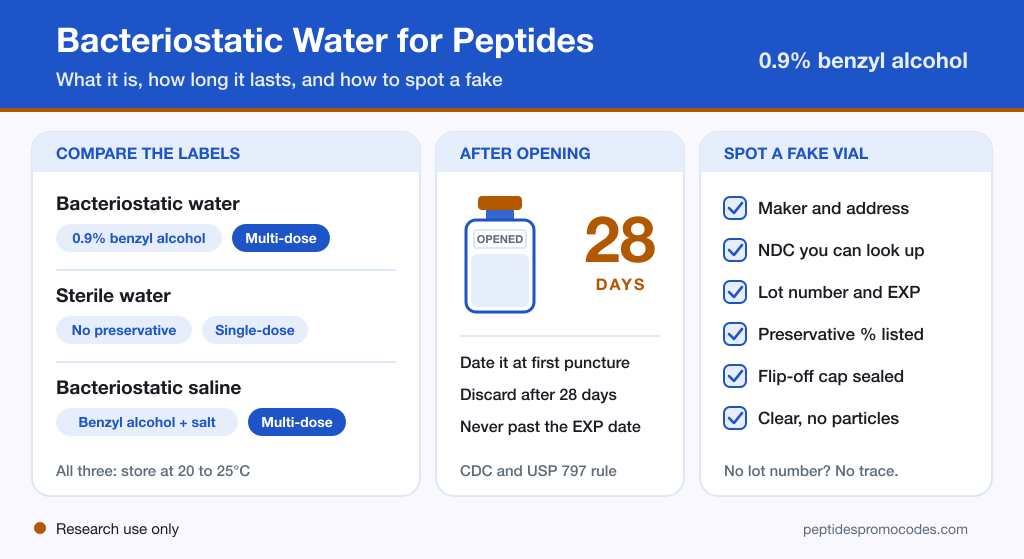
Here is how the three labels compare.
| Bacteriostatic water | Sterile water for injection | Bacteriostatic saline | |
|---|---|---|---|
| What’s in it | Water, 0.9% benzyl alcohol | Water only | Water, 0.9% sodium chloride, 0.9% benzyl alcohol |
| Preservative | Yes | None | Yes |
| Vial type | Multiple-dose | Single-dose | Multiple-dose |
| After first use | Date it, discard within 28 days | Discard what’s left | Date it, discard within 28 days |
| Label storage | 20 to 25°C | 20 to 25°C | 20 to 25°C |
Sterile water contains “no bacteriostat, antimicrobial agent or added buffer”, and its label says to discard the unused portion. Once you puncture it, nothing holds back bacteria that get in.
Bacteriostatic Sodium Chloride vs Bacteriostatic Water
Bacteriostatic saline has the same preservative plus 0.9% sodium chloride (salt). Its label says to follow the drug maker’s instructions, and warns that some drugs are incompatible with a given liquid.
Research peptides rarely come with that instruction. GenScript’s solubility guide says a peptide’s solubility depends on its sequence and on salts in the powder. It suggests starting with sterile water and testing a tiny amount first. So saline may suit some peptides and not others. If your supplier or certificate of analysis names a solvent, follow it.
Either way, the concentration math is the same: milligrams of peptide divided by millilitres of liquid. So 5 mg in 2 mL gives 2.5 mg/mL. Our Peptide Reconstitution Calculator does the sums, and our guide to peptide units vs mg explains why “units” are not milligrams.
How Long Is Bacteriostatic Water Good for After Opening?
Hospira’s label doesn’t print a discard date for an opened vial. The 28-day figure comes from the CDC and USP chapter 797, the US standard for preparing sterile products. The CDC says an opened multi-dose vial “should be dated and discarded within 28 days unless the manufacturer states another date.”
In practice:
- Write the date on the vial the first time you puncture the stopper.
- Discard it 28 days later, even if water is left.
- Discard it sooner if it reaches its printed expiry date.
- Discard it any time you suspect contamination.
Every entry is a chance for contamination. The label calls for aseptic technique (keeping germs out) on every entry, and says to clean the stopper with antiseptic first.
Does Bacteriostatic Water Expire?
Yes. Every genuine vial has an expiry date printed next to its lot number. The CDC says an unopened multi-dose vial should be discarded by the maker’s expiration date.
Is an Unopened Vial Past Its Date Still Usable?
This comes up often in peptide research communities, usually about a sealed vial that expired a year ago. The expiry date is the last day the maker vouches for sterility and preservative strength. The FDA’s view is plain: once that date has passed, “there is no guarantee that the medicine will be safe and effective.” It also warns that some expired medicines are at risk of bacterial growth. Treat an expired vial as unverified, sealed or not.
How Should You Store Bacteriostatic Water?
The label says to store it at 20 to 25°C (68 to 77°F), which is controlled room temperature. It gives no separate condition for an opened vial.
Keep one point in mind: the preservative protects the water, not your peptide. It does not stop a dissolved peptide from breaking down. Peptide maker Bachem advises against storing peptides in solution long term. Our guide to peptide reconstitution problems covers storage after mixing.
Why Did My Peptide Turn Cloudy in Bacteriostatic Water?
Side-by-side photos are a common sight in peptide communities: the same peptide, clear in one brand of water and cloudy in another. Cloudiness tells you something is off. It doesn’t tell you what.
First, check the water alone. Hospira’s vial says to use it only if clear, with the seal intact. Cloudy water, or particles in the vial, fails before any peptide goes in.
If clear water turned cloudy after mixing, the usual suspects are:
- The peptide hasn’t fully dissolved. Bachem notes reconstitution can occasionally take several hours.
- The peptide has clumped (aggregated). In one lab study, a freeze-dried protein formed more clumps with 0.9% benzyl alcohol than with plain water.
- The water is contaminated or mislabeled. Cloudiness is also how bacterial growth shows up in a clear liquid.
- The powder isn’t what its label says.
If the same peptide stays clear in one water and clouds in another, the water is the variable. Set that vial aside and note its lot number.
How to Tell if Bacteriostatic Water Is Fake
You can’t check sterility by eye, but you can check whether a vial is traceable. Look for:
- A named maker or distributor with an address. Hospira’s reads “Dist. by Hospira, Inc., Lake Forest, IL”.
- An NDC (National Drug Code). This is the FDA’s three-part code for labeler, product and package. Hospira’s 30 mL plastic vial is NDC 0409-3977-01. Look it up in the FDA NDC Directory or on DailyMed and check that the labeler matches. An NDC alone is not proof of FDA approval.
- A lot number and expiry date printed on the vial.
- The preservative and its strength, such as “0.9% benzyl alcohol added”.
- “Multiple-dose” and a newborn warning on the label.
- An intact flip-off cap and undamaged stopper.
- Clear liquid with no particles.
The FDA lists unusual appearance or packaging as a warning sign of counterfeit medicine, and advises buying from state-licensed pharmacies.
Does a Different Label Mean It’s Counterfeit?
Not by itself. Label designs change, and DailyMed lists several repackagers that sell bacteriostatic water under their own name and NDC. If the NDC, labeler, lot or expiry doesn’t match, contact the seller and the named maker before you use it.
What Happens When a Lot Goes Bad?
Bad batches happen, even at licensed plants. In 2019, the FDA posted a voluntary recall of one lot of 30 mL bacteriostatic water because sterilization could not be confirmed for some vials. The notice named the lot number and expiry date. Research suppliers sometimes flag a bad batch of their own water too. Either way, the lot number tells you whether your vial is affected. Water with no lot number can’t be traced.
Hospira Bacteriostatic Water vs Vendor-Supplied Water
Hospira bacteriostatic water is the pharmacy-grade benchmark many researchers compare against. Its label, NDCs and lot format are public on DailyMed, so you can check a vial against the source.
Water bundled by a peptide supplier may be fine. The question is whether you can verify it. Ask who makes it, whether each vial shows a lot and expiry, and what the benzyl alcohol content is. If the answers are vague, a pharmacy-grade vial removes the guesswork. Our guide to peptide testing labs covers independent checks.
What about buying Hospira cheaply at a local pharmacy? In the US, the vial is labeled “Rx only”, making it a prescription product. Whether a pharmacy will supply it, and at what price, is up to the pharmacy and local rules.
Plastic vs Glass Vials: Does It Matter?
For the water, both are legitimate. Hospira sells a 30 mL plastic vial made of polyolefin, and the label says it passed USP biological tests for plastic containers. The glass vial holds 20 mL and uses 1.1% benzyl alcohol instead of 0.9%.
For the peptide, container walls matter most at very low concentrations. A 2015 PLOS ONE study found three positively charged peptides stuck quickly to both glass and polypropylene. At low concentrations, 90% or more could be lost from solution, and low-binding tubes cut the loss. It tested only three peptides.
Why the Water Matters as Much as the Peptide
A certificate of analysis covers the powder, not the water you add. A 99% pure peptide in contaminated water is a contaminated sample. So hold the water to the same standard: named maker, lot number, expiry date and sealed cap. Our guide on how to read a peptide COA covers the peptide side.
Research peptides are sold for laboratory research use only. They are not for human or veterinary use.
Frequently Asked Questions
Is bacteriostatic water the same as sterile water?
No. Sterile water has no preservative and is single-dose, so you discard what’s left. Bacteriostatic water contains 0.9% benzyl alcohol and is multiple-dose.
How long does bacteriostatic water last once opened?
The CDC and USP chapter 797 say to discard an opened multi-dose vial within 28 days, unless the maker says otherwise. Never use it past its printed expiry date.
Can I use bacteriostatic saline instead of bacteriostatic water?
Sometimes. It has the same preservative plus salt, and salts can affect how some peptides dissolve. Follow your supplier’s solvent guidance, and test a small amount first if there is none.
How can I tell if my bacteriostatic water is fake?
Check for a named maker, an NDC you can look up, a printed lot and expiry, and an intact cap. Don’t use cloudy water.
Should bacteriostatic water be refrigerated?
Hospira’s label says to store it at 20 to 25°C (68 to 77°F). It gives no separate condition for an opened vial. Once mixed, follow the storage rules for the peptide.
Work out concentrations with our Peptide Reconstitution Calculator, compare suppliers in our directory, and read our buyer’s guide and peptide scams guide before you order.
Sources
- Bacteriostatic Water for Injection, USP (Hospira), DailyMed: benzyl alcohol content, vial types, NDCs, storage and the “use only if clear” instruction.
- Sterile Water for Injection, USP (Hospira), DailyMed: no preservative, single-dose containers only, discard the unused portion.
- Bacteriostatic 0.9% Sodium Chloride Injection, USP (Hospira), DailyMed: composition and the warning on compatibility.
- Preventing Unsafe Injection Practices, CDC: the 28-day rule for opened multi-dose vials.
- Don’t Be Tempted to Use Expired Medicines, FDA: why expiry dates matter and the risk of bacterial growth.
- Roy et al. (2005), benzyl alcohol and protein aggregation, Journal of Pharmaceutical Sciences, PubMed: more aggregation on reconstitution with 0.9% benzyl alcohol than with water.