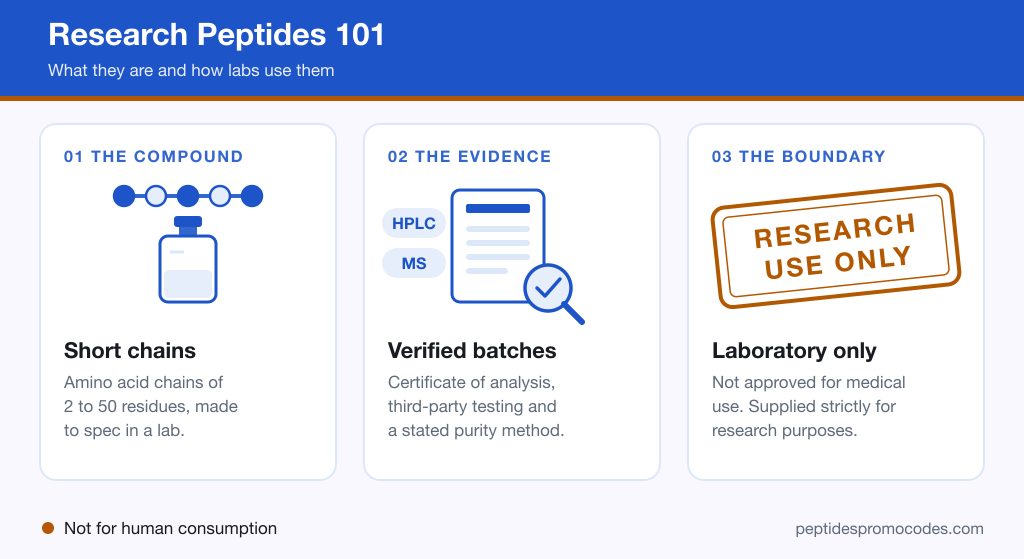
A peptide is a chain of amino acids that stops well short of the length of a full protein. Under the international nomenclature rules, chains of more than about 50 residues are usually called proteins, though authors draw that line in different places. That compactness is exactly why the category matters to science: a peptide is short enough to synthesise, purify, and characterize cleanly, yet still long enough to carry real biological activity. Sitting in that gap makes peptides unusually good experimental tools.
“Research peptides” is the label the laboratory supply world uses for compounds produced specifically for that experimental work. They are not medicines, they are not supplements, and they carry no approval for use in people. This article explains what the term actually covers, traces how the field arrived at its current methods, walks through the research areas where these compounds show up, and looks at the practical obstacles — stability, purity, and verification — that shape day-to-day laboratory work.
Key Takeaways
- Definition: Peptides are short amino acid chains, generally described as 2 to 50 residues, biologically meaningful yet structurally simple enough to study directly.
- Purpose: Synthetic research peptides are produced under controlled laboratory conditions specifically to probe cell signaling, protein interactions, and underlying biological mechanisms.
- Method: Modern synthesis routes and analytical instrumentation together let researchers examine those mechanisms at a level of precision earlier generations could not reach.
- Status: Research peptides are a fundamentally different category from approved peptide medications, and they exist for experimental laboratory use alone.
- Scope: The field reaches across drug discovery, vaccine science, tissue repair, individualised medicine, antimicrobial work, and neurodegenerative disease research.
What Are Research Peptides?
Research peptides are amino acid sequences assembled in a controlled laboratory setting and built to defined specifications for scientific investigation. Unlike material made for general consumption, each batch is expected to meet demanding standards for purity and composition, because an experiment is only as trustworthy as the reagent behind it.
In practice, these compounds do several distinct jobs on the bench:
- Molecular probes: they let researchers trace how signals move through a cell and where a pathway begins or terminates.
- Interaction studies: they provide a defined partner for examining how proteins recognize and bind to one another.
- Method development: they support the creation of new analytical techniques in biochemistry.
- Calibration standards: their known composition makes them useful reference points for instrument setup.
- Basic biology: they help dissect fundamental processes that would be difficult to isolate any other way.
Reputable material arrives with a documentation package rather than just a label. Mass spectrometry data and purity analyses accompany the vial so that the person running the experiment can confirm identity and composition before anything is used. That paper trail is what makes results reproducible; without it, an unexpected outcome cannot be separated from an unexpected reagent. If the underlying chemistry is unfamiliar, our overview of what peptides are and the explanation of how peptides differ from proteins cover the groundwork.
From Historical Discovery to Modern Peptide Research
The modern field rests on a sequence of breakthroughs that each removed a practical barrier.
- 1921–22 — insulin isolated. Frederick Banting and Charles Best, working in John Macleod’s Toronto laboratory, isolated insulin in 1921, and in January 1922 a purified extract successfully treated a patient with diabetes. Insulin became the first commercial peptide drug in 1923, the same year Banting and Macleod received the Nobel Prize for its discovery. The work established that short amino acid chains could act as powerful biological signals.
- 1950s — oxytocin synthesised. Vincent du Vigneaud achieved the first chemical synthesis of oxytocin, work the Nobel committee cited as the first synthesis of a polypeptide hormone, proving that a biologically active peptide could be constructed artificially rather than only extracted from tissue.
- 1960s — solid-phase peptide synthesis. Bruce Merrifield introduced SPPS in 1963, the approach that turned peptide construction from a specialist feat into a repeatable laboratory procedure and earned him the 1984 Nobel Prize in Chemistry. The mechanics of that method are covered in our guide to how peptides are synthesised.
Analysis advanced alongside production. Mass spectrometry and X-ray crystallography now let researchers confirm sequence, mass, and three-dimensional arrangement with a precision that would have been unattainable when the field began. Together, better synthesis and better analysis mean that a peptide used today can be described exactly, not approximately.
The result is a category that spans the full range of the life sciences, from foundational biochemistry through to early drug discovery. Size, stability, and retained biological activity are the three properties that keep peptides in constant laboratory use.
Research Peptides vs FDA-Approved Medications
This distinction is the most important one in the whole subject, and it is frequently blurred.
Regulatory agencies including the FDA have approved more than 80 peptide drugs worldwide. Those products moved through clinical trials, were assessed against a formal safety and efficacy framework, and carry an approved indication, a defined manufacturing standard, and prescribing information.
Research peptides sit outside that framework entirely. They are intended strictly for scientific investigation inside controlled laboratory environments, and they are not approved for medical use. Their function is to help researchers understand biological mechanisms and explore where a therapeutic application might eventually exist — a stage that comes long before anything approaches a patient.
| Attribute | Approved peptide medication | Research peptide |
|---|---|---|
| Regulatory review | Assessed through clinical trials and a formal approval pathway | No approval for medical use |
| Intended setting | Clinical care under professional supervision | Controlled laboratory environment only |
| Purpose | Treating a defined, approved indication | Investigating biological mechanisms |
| Documentation | Prescribing information and approved labeling | Certificate of analysis and purity data |
| Human use | Permitted within the approved indication | Not permitted; research use only |
The presence of a compound in a supplier catalogue says nothing about its approval status. Those are two separate questions, and only the second one carries any regulatory weight. A label does not change that either: the FDA has warned companies selling unapproved drugs that were falsely labeled “for research purposes” or “not for human consumption.”
Therapeutic Applications in Scientific Research
The word “therapeutic” here describes the research question, not a treatment being offered. The areas below are all fields of laboratory study.
| Research area | What is being studied | Typical laboratory role |
|---|---|---|
| Pharmaceutical research and drug design | Molecular mechanisms behind disease pathways | Peptide models of specific interactions |
| Cell therapy and vaccine development | Antigen recognition and immune response | Synthetic peptide libraries |
| Growth factor and regenerative medicine | Tissue repair and cellular regeneration | Controlled interaction studies |
| Personalized medicine | Neo-epitopes arising from genetic mutations | Sequence-specific recognition assays |
| Antimicrobial peptide research | Activity against resistant pathogens | Structure-activity comparisons |
| Neurodegenerative disease research | Protein aggregation and neural signaling | Laboratory disease models |
Pharmaceutical Research and Drug Design
Two properties make peptides attractive early in drug discovery: high specificity and comparatively simple structure. A short, well-defined sequence can be used to interrogate one molecular mechanism at a time. Researchers build peptide models to examine the pathways involved in a range of conditions, with cancer biology and autoimmune disorders among the areas where this approach is applied.
Cell Therapy and Vaccine Development
Synthetic peptides give immunologists a controlled way to study antigen recognition — how the immune system identifies a specific molecular pattern. Laboratory work of this kind supports investigation into immune response mechanisms more broadly, and this foundational research feeds into experimental vaccine platforms. Peptide libraries, which present many defined sequences in parallel, make it possible to study which particular sequences trigger which immune responses.
Growth Factor and Regenerative Medicine Research
Here the focus is how peptides interact with growth factors and what that reveals about repair. Studies examine tissue repair mechanisms and the processes behind cellular regeneration. BPC-157 is one compound investigated in this context, studied under controlled laboratory conditions to understand fundamental mechanisms of tissue recovery. This remains an active area of investigation rather than a settled one: a 2025 systematic review found 35 preclinical studies and a single clinical study, and no clinical safety data.
Personalized Medicine Research
Genetic mutations can produce novel protein sequences known as neo-epitopes, which do not exist in unmutated tissue. Synthesising these sequences as peptides allows researchers to study individualised approaches in a laboratory setting, and the idea has reached early clinical testing: in a 2017 melanoma study, each patient’s vaccine was built from synthetic long peptides matching up to 20 of their own tumour mutations. Synthetic peptide libraries again do much of the work, letting scientists examine cellular recognition patterns and map molecular interactions systematically.
Antimicrobial Peptide Research
Rising antibiotic resistance among bacteria has made antimicrobial peptides, or AMPs, a considerably more prominent research subject, studied as candidates to get around that resistance. Laboratory studies look at naturally occurring antimicrobial molecules, investigate the mechanisms by which they act against pathogens, and explore how structural modifications change antimicrobial activity. The aim is to understand what makes these molecules effective at a structural level.
Neurodegenerative Disease Research
Synthetic peptides are used to investigate protein aggregation, one of the defining features of several neurodegenerative conditions. Related work examines neural signaling pathways and explores potential protective mechanisms within laboratory models. The value of these studies is in illuminating molecular processes that are otherwise extremely difficult to observe directly. The chemistry of the peptide bond is what governs how these sequences fold and aggregate in the first place.
Overcoming Challenges in Peptide Research
Working with peptides brings a set of recurring practical problems. None are insurmountable, but all of them affect data quality.
Stability and storage
Peptides need precise storage conditions to retain their structural integrity. Temperature fluctuations, exposure to light, and improper handling can all compromise stability, and a degraded peptide will quietly distort experimental outcomes rather than announcing the problem. Storage discipline is part of experimental design, not an afterthought.
Purity and quality control
Achieving consistent purity through synthesis remains genuinely difficult. Quality control depends on analytical methods including HPLC and mass spectrometry to confirm what a batch actually contains. The margin here is narrow: even minor contamination can meaningfully alter results, which is why analysis is repeated rather than assumed. In one documented case, a stray peptide making up about 1% of a commercial sample by weight was enough to produce false-positive immune-assay results.
Experimental design
Studying peptide-protein interactions requires carefully constructed experiments with appropriate controls. Peptide behavior in the laboratory shifts with pH, temperature, and ionic conditions, so those variables have to be specified and held steady if results are to be comparable across runs.
Evaluating any supplier
Because the quality of the starting material determines the quality of the result, supplier assessment is a technical exercise rather than a matter of preference. Regardless of which supplier is under consideration, the same evidence should be available:
- Comprehensive certificates of analysis: a CoA for the specific batch on offer, not a generic example document.
- Third-party laboratory testing: independent verification carries more weight than in-house results alone.
- Detailed purity specifications: a stated purity figure with the method used to determine it.
- Clear labeling: accurate identity, batch number, and an explicit research-use-only statement.
- Storage and handling guidance: documented conditions for keeping material stable on arrival and in use.
If any of that documentation is missing or cannot be produced on request, that absence is itself the finding. Our buyer’s guide sets out how to work through these checks in a consistent order.
Future Outlook for Research Peptides
Several developments are shaping where the field goes next.
- Computational prediction: artificial intelligence and machine learning are increasingly used to predict peptide structure, and improved models are raising the accuracy of interaction predictions.
- Better analytics: refinements in analytical technique allow peptide-protein interactions to be studied with greater precision.
- Individualised research: personalized medicine studies continue to investigate sequences unique to a particular biological context.
- Delivery systems: advanced drug delivery remains an active line of investigation.
- Interaction mapping: systematic mapping of protein-protein interactions is a growing research direction.
- Biosensors: novel peptide-based biosensor development is an emerging application.
- Beyond the clinic: environmental and agricultural uses, along with green chemistry initiatives, extend the field past biomedical research.
Peptide research is expanding on multiple fronts at once, and rising demand for well-characterized research compounds is likely to accelerate that. What should not move is the standard applied to the work. As the field grows and the questions get more ambitious, rigorous documentation, verified purity, and disciplined handling remain the conditions under which any of these results mean anything.
Research peptides are supplied strictly for laboratory research and experimental purposes. They are not approved for medical use and are not intended for human or veterinary consumption. Nothing here is medical advice; consult a qualified healthcare professional for any question about health, treatment, or medication.
Sources
- IUPAC-IUB Joint Commission on Biochemical Nomenclature: Nomenclature and Symbolism for Amino Acids and Peptides, rule 3AA-11 (1983): oligopeptide, polypeptide and protein terms, and why the 50-residue line varies by author.
- 100 Years since the Discovery of Insulin, from Its Discovery to the Insulins of the Future (Biomedicines, 2024): the 1921 Toronto work, the first successful patient in January 1922, and the 1923 Nobel Prize to Banting and Macleod.
- Therapeutic peptides: current applications and future directions (Signal Transduction and Targeted Therapy, 2022): insulin as the first commercial peptide drug, Merrifield’s 1963 SPPS method, and more than 80 approved peptide drugs.
- The Nobel Prize in Chemistry 1955 (NobelPrize.org): du Vigneaud’s prize for the first synthesis of a polypeptide hormone.
- The Nobel Prize in Chemistry 1984 (NobelPrize.org): Merrifield’s prize for chemical synthesis on a solid matrix.
- FDA’s Concerns with Unapproved GLP-1 Drugs Used for Weight Loss (FDA): warnings to companies selling unapproved drugs falsely labeled “for research purposes.”
- An immunogenic personal neoantigen vaccine for patients with melanoma (Nature, 2017): personal vaccines built from synthetic long peptides targeting up to 20 neoantigens per patient.
- Antimicrobial peptides: mechanism of action, activity and clinical potential (Military Medical Research, 2021): antibiotic resistance and AMPs as candidates to overcome it.
- Emerging Use of BPC-157 in Orthopaedic Sports Medicine: A Systematic Review (HSS Journal, 2025): 35 preclinical studies, 1 clinical study and no clinical safety data.
- Peptide impurities in commercial synthetic peptides and their implications for vaccine trial assessment (Clinical and Vaccine Immunology, 2008): about 1% contaminating peptide caused false-positive T-cell results.