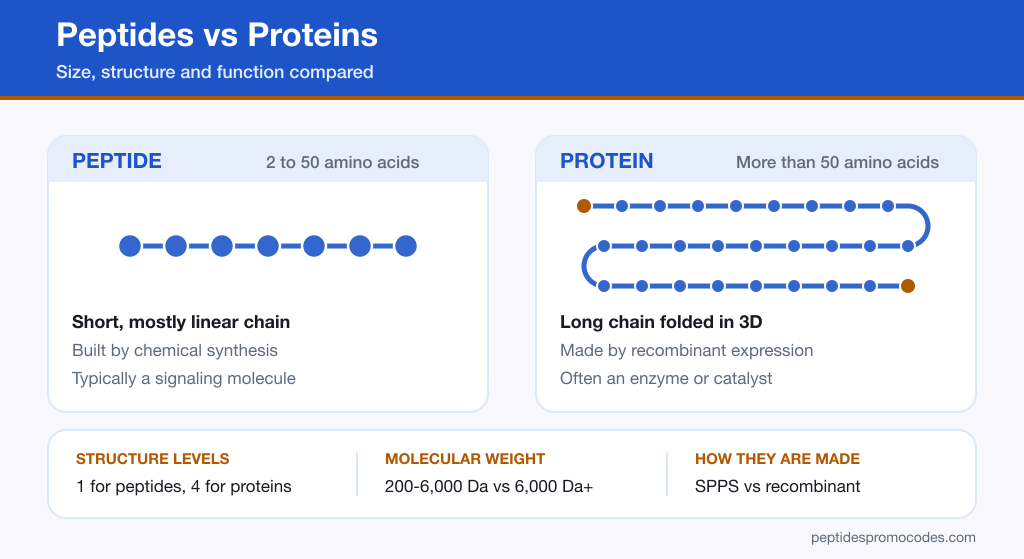
Peptides and proteins sit at the center of nearly every biological process, in every kingdom of life. They are built the same way — amino acids strung together through peptide bonds — but the similarities stop being useful fairly quickly. Their size, the shapes they can adopt, and the jobs they end up doing inside a cell diverge in ways that shape how each one is studied, produced, and handled.
This article walks through that divergence: what defines each class of molecule, how they differ in structure and behavior, why laboratories choose one over the other, and which technologies are changing the picture. A quick reference table near the end condenses the whole comparison into one view.
What Peptides and Proteins Actually Are
Both are polymers of amino acids. Individual amino acids join when the carboxyl group (-COOH) on one reacts with the amino group (-NH2) on the next in a condensation reaction, releasing water and leaving behind the covalent link known as a peptide bond. Repeat that reaction and you get a chain. How long that chain runs is the first thing that separates a peptide from a protein.
Peptides are the short end of the spectrum, generally holding somewhere between 2 and 50 amino acid residues. The vocabulary gets more specific as the chain grows:
- Dipeptides: two amino acid residues.
- Tripeptides: three residues.
- Oligopeptides: sequences running up to roughly 10 to 20 residues.
- Polypeptides: longer chains. Past about 50 residues, a polypeptide of defined sequence is usually called a protein, though authors differ on where that line falls.
Proteins are the macromolecules on the other end. A protein is built from one or more polypeptide chains, each of which typically carries more than 50 amino acids, and the total count can climb from dozens into the thousands. Length alone is a convenient shorthand, though it undersells the real distinction — what genuinely separates the two classes is structural organisation and functional complexity. A short chain and a folded macromolecule do not behave like scaled versions of one another.
Functional Differences Between Peptides and Proteins
Size and composition
Peptides in the 2-50 residue range land at molecular weights spanning several hundred to a few thousand daltons; therapeutic peptides usually weigh 500-5,000 Da. Because those chains are short and largely linear, the number of conformations they can settle into is limited. There is simply not enough chain to fold in many interesting ways.
Proteins operate at a different scale entirely, reaching molecular weights in the hundreds of thousands of daltons. They also carry components peptides usually lack: several polypeptide chains assembled together, prosthetic groups, and an assortment of chemical modifications. Many proteins are further divided into discrete domains, each handling its own specific function within the larger molecule.
Complexity and folding
Folding is where the gap widens most. Peptides show limited folding complexity. Elements of secondary structure do appear in them, but they rarely assemble into the elaborate three-dimensional architectures that proteins depend on.
Proteins organize themselves across four recognized levels:
- Primary structure: the amino acid sequence itself, read in linear order.
- Secondary structure: localised repeating conformations — alpha helices and beta sheets — held in place by hydrogen bonding.
- Tertiary structure: the complete three-dimensional shape adopted by a single polypeptide chain, stabilized by a mix of chemical interactions.
- Quaternary structure: how multiple polypeptide chains position themselves relative to each other to form one working protein complex.
That layered hierarchy is what lets proteins hold precise, stable conformations, and those conformations are what make their biological functions possible in the first place. Take the folding away and the function goes with it.
Peptides vs Proteins in Research and Therapeutic Applications
How each one is produced
Manufacturing is one of the clearest practical advantages peptides have. A short sequence can be assembled through solid-phase peptide synthesis (SPPS), a chemical route that delivers high purity and reproducible results batch after batch. Proteins generally cannot be made that way. They require recombinant expression, which means growing them in living systems — bacterial, yeast, insect, or mammalian cell cultures — and then purifying the product out of that biological background.
Stability under real conditions
The stability picture is not one-sided. A short peptide has little or no folded structure, so there is no delicate three-dimensional shape for heat or a pH shift to unfold, the way those stresses denature a protein. That does not make peptides robust, though. Without the protection a folded structure gives, their amide bonds are exposed and easily cut by enzymes, so many natural peptides are chemically unstable and short-lived in the body.
What each class does well
Molecular size drives a set of predictable behavioral differences in a research setting.
Peptides generally offer:
- Small size: a short chain is cheaper to make and easier to analyse, although most peptides cross cell membranes poorly.
- Simpler modification: short sequences are more straightforward to alter chemically.
- Lower immunogenicity: they are less likely to provoke an immune response than protein drugs.
- No fold to protect: there is little three-dimensional structure to lose, although the chain itself can still degrade.
Proteins generally offer:
- Large binding surfaces: room for many contact points on a target, as in antibodies.
- Multiple functional domains: distinct regions doing distinct jobs within one molecule.
- Longer biological half-lives: they persist longer in biological systems.
- Complex interaction capability: the ability to participate in intricate molecular interactions.
Where each one gets used
Those properties map onto different experimental questions. Peptides show up regularly in receptor binding work, structure-activity relationship studies, protein-protein interaction mapping, and enzyme inhibition assays. Proteins dominate elsewhere — enzyme replacement studies, antibody-based research, structural biology, and the analysis of complex cellular pathways. Anyone selecting compounds for a study will find it useful to read this alongside a broader overview of research peptides and how they are classified.
Quick Reference Table
| Characteristic | Peptides | Proteins |
|---|---|---|
| Size | 2-50 amino acids | More than 50 amino acids |
| Molecular weight | Typically 200-6,000 Da | Usually above 6,000 Da; can exceed 1,000,000 Da |
| Structural complexity | Mainly primary, with limited secondary structure | Primary, secondary, tertiary, and quaternary structure |
| Folding properties | Limited folding | Complex folding patterns |
| Synthesis | Chemical synthesis (SPPS) | Recombinant expression |
| Stability | Little structure to denature, but readily broken down by enzymes | Folded structure sensitive to heat and pH |
| Structural features | Linear or simple cyclic structures | Complex three-dimensional structures |
| Typical functions | Signaling molecules | Enzymatic catalysis |
| Research applications | Receptor binding studies | Enzyme studies |
| Analytical methods | Mass spectrometry | X-ray crystallography |
Future Applications and Emerging Technologies
Computational design and prediction
Machine learning and artificial intelligence have reshaped how structure is determined. Deep learning models such as AlphaFold have dramatically improved the accuracy of protein structure prediction, often matching experimentally determined structures, and a newer generation of computational tools now supports rational design — building molecules to specification rather than discovering them by screening.
Advanced synthesis technologies
Chemical ligation, which joins unprotected peptide segments with a native peptide bond, and enzymatic synthesis methods are pushing peptide production toward longer sequences at higher yields. On the protein side, cell-free expression systems and continuous-flow manufacturing are making production more efficient. Synthetic biology adds another dimension by allowing non-natural amino acids and novel chemical modifications to be built directly into a sequence.
Analytical technologies
The tools used to examine these molecules are improving in parallel. Cryo-electron microscopy, recognised with the 2017 Nobel Prize in Chemistry, resolves protein complexes at higher detail than was previously possible. Advanced mass spectrometry characterizes modifications and interactions more thoroughly. Single-molecule analysis exposes folding behavior and dynamics that averaged measurements obscure.
Integration with other technologies
Peptide and protein science is also converging with adjacent fields:
- Nanotechnology: peptide-based nanomaterials and protein-engineered nanostructures.
- Biosensors: highly sensitive detection systems built around engineered peptides and proteins.
- Synthetic biology: designed molecules incorporated into engineered biological systems.
- Biomaterials: materials whose properties are programmed through protein and peptide structure.
Why the Distinction Matters
The peptide-protein boundary is not a piece of trivia. It determines how a compound can be manufactured, how it should be stored, how it moves through tissue, how long it lasts, and which analytical method will actually tell you what you have. Choosing between them is really a choice between synthetic simplicity and functional sophistication, and the right answer depends entirely on the question being asked. If you are new to the category, a general introduction to peptides covers the wider context these molecules sit in.
Compounds discussed here are intended for laboratory research use only, not for human or animal consumption. Understanding whether you are working with a peptide or a protein should inform your handling, storage, and analytical choices, and any question touching on health should go to a qualified healthcare professional.
Sources
- IUPAC-IUB Joint Commission on Biochemical Nomenclature: Nomenclature and Symbolism for Amino Acids and Peptides, rules 3AA-11 and 3AA-12 (1983): oligopeptide, polypeptide and protein terms, the 50-residue convention, and the loss of water when amino acids join.
- Alberts et al., The Shape and Structure of Proteins, Molecular Biology of the Cell, 4th edition (NCBI Bookshelf, 2002): the four levels of protein structure, hydrogen-bonded helices and sheets, and protein domains.
- Therapeutic peptides: current applications and future directions (Signal Transduction and Targeted Therapy, 2022): peptide molecular weights, lower immunogenicity than biologics, and poor stability without folded structure.
- A concise guide to choosing suitable gene expression systems for recombinant protein production (STAR Protocols, 2023): E. coli, yeast, insect and mammalian expression, plus cell-free expression.
- Highly accurate protein structure prediction with AlphaFold (Nature, 2021): structure prediction competitive with experimental structures in most CASP14 cases.
- Synthesis of proteins by native chemical ligation (Science, 1994): joining unprotected peptide segments to make proteins of moderate size.
- The Nobel Prize in Chemistry 2017 (NobelPrize.org): cryo-electron microscopy for high-resolution structures of biomolecules.