Building a peptide to an exact specification is one of the foundational skills of modern biochemistry. Because the sequence can be dictated residue by residue, laboratories are able to reproduce chains that occur in nature and also invent variants that nature never made, then compare the two side by side. That capability underpins a large share of what is currently known about how proteins recognize one another, how enzymes act on their substrates, and how signals travel through a cell.
The technique that made this routine arrived in 1963, when Bruce Merrifield introduced solid phase peptide synthesis, usually abbreviated to SPPS. The method earned him the 1984 Nobel Prize in Chemistry. Since then, synthetic chains have functioned less as end products and more as instruments: defined molecular probes used to interrogate biological systems. The sections below walk through the underlying chemistry, the practicalities of running a synthesis, the analytical work that confirms you made what you intended, and the ways the finished material is put to use. For background on the molecules themselves, see our overview of what peptides are and our guide to research peptides.
The Chemistry Behind Peptide Synthesis
How amino acids are joined together
Every link in a peptide chain is created by a nucleophilic addition-elimination reaction. The carboxyl group belonging to one amino acid is attacked by the amino group of the next, and the net result is the loss of one molecule of water as the new bond closes. That is the same connection described in more detail in our article on the peptide bond.
Left alone, the reaction is far too sluggish to be useful, so the carboxyl group has to be chemically activated before it will couple at a workable rate. In practice it is the activating group, not water, that leaves during the coupling step. Activation introduces its own problem, however: the conditions that make a residue reactive also make it easier for that residue to lose its stereochemical integrity. Controlling the coupling step carefully is therefore not optional, because racemization is the price of getting the reaction to run quickly.
Protecting group strategies
A growing chain contains many reactive groups, and only one of them should be reacting at any given moment. Protecting groups solve this by acting as temporary chemical shields, blocking the functionality you want to leave alone until you deliberately remove the block.
Two protecting groups dominate work at the N-terminus, and they are removed under opposite conditions:
| Consideration | Fmoc | Boc |
|---|---|---|
| Chemical character | Base-labile | Acid-labile |
| Removal conditions | Cleaved with piperidine | Cleaved with trifluoroacetic acid (TFA) |
| Monitoring option | Removal can be tracked quantitatively by UV spectroscopy | Not tracked by the Fmoc UV method |
Alongside whichever N-terminal group is chosen, reactive side chains carry protection of their own. The critical design requirement is orthogonality: side chain protection must be stable to the conditions used to strip the N-terminal group, so that each round of deprotection exposes only the single amine you want to extend from. It is one reason Fmoc chemistry is now used for the majority of synthetic peptides: in the Boc scheme, the repeated acid treatments could strip small amounts of side-chain protection at every cycle, whereas Fmoc pairs a base-labile temporary group with acid-labile permanent ones.
Activation methods
Several families of reagents are used to turn a carboxyl group into something that will couple readily. They differ in speed, in cost, and in how much they suppress side reactions:
- Carbodiimides: DCC and EDC convert the carboxyl group into a reactive O-acylisourea intermediate.
- Active esters: additives such as HOBt and HOAt form active esters that speed up carbodiimide couplings and suppress racemization.
- Phosphonium and uronium salts: PyBOP and HATU are the reagents to reach for when couplings need to be fast, giving coupling kinetics even faster than carbodiimides.
- In situ activation: rather than isolating an activated species, several reagents are combined in the reaction vessel and the activation happens on the spot.
Side reactions and difficult sequences
A synthesis rarely fails outright. More often it degrades gradually, and the resulting impurities are what analytical work later has to find:
- Racemization: the persistent background concern whenever an amino acid is activated.
- Diketopiperazine formation: at the dipeptide stage, the free amine can attack its own resin linkage and release the first two residues as a cyclic diketopiperazine, particularly when glycine or proline sits in one of the first two positions.
- Aspartimide formation: a recognized hazard in stretches that include aspartic acid, triggered by the repeated base treatments of Fmoc removal.
- Deletion sequences: when a deprotection or a coupling does not go to completion, chains missing one or more residues accumulate in the mixture.
- Aggregation and secondary structure: as the chain grows, resin-bound chains can stick to one another through backbone hydrogen bonds, which makes subsequent steps harder. These are the so-called difficult sequences.
Solid-Phase Peptide Synthesis
Why the solid support matters
In SPPS the chain is tethered to an insoluble support while it is being assembled. That single design choice is what makes the method practical, because reagents and by-products can be flushed away by simple filtration and washing between steps, with no need to isolate an intermediate after every reaction. The Nobel committee’s own arithmetic shows why that matters: at 90% yield per step, a 100-step synthesis delivers about 0.003% of the product overall, while the 99.5% per-step yields possible on a solid support give about 61%.
The supports themselves are typically cross-linked polystyrene or resins that incorporate polyethylene glycol. Each resin is functionalised with a linker, and the identity of that linker determines what the C-terminus of the finished peptide will look like once the chain is released from the support.
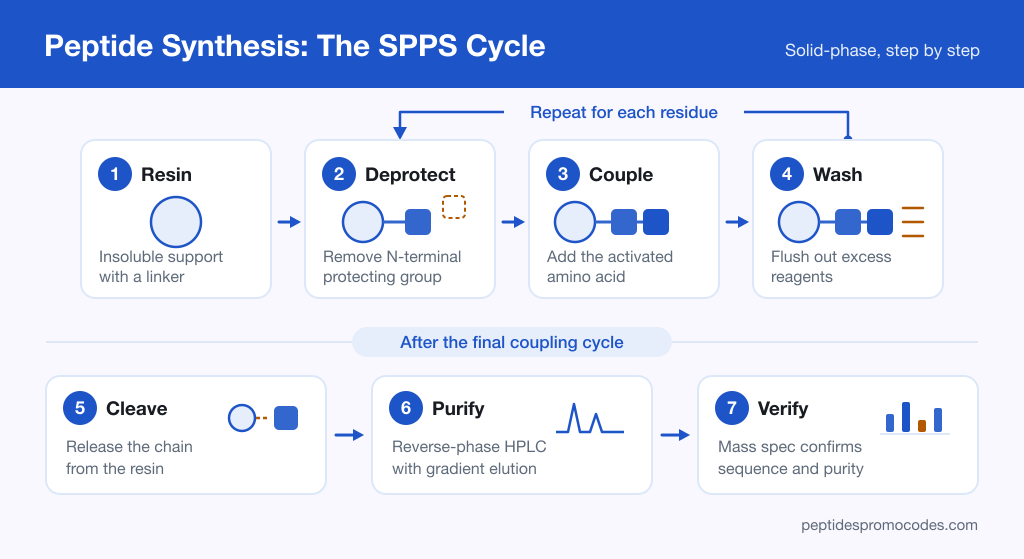
The repeating operation is short and is run once per residue:
- Anchor the first residue. The C-terminal amino acid is attached to the linker on the resin.
- Deprotect. The N-terminal protecting group is removed, exposing a free amine on the resin-bound chain.
- Wash. Reagents and by-products from the deprotection are filtered and rinsed away.
- Couple. The next amino acid, its carboxyl group activated, is added and forms the new peptide bond.
- Wash again. Excess reagent and soluble by-products are removed before the next cycle begins.
- Repeat. Steps 2 through 5 are run again for every remaining residue in the sequence.
- Release and purify. The completed chain is cleaved from the resin and taken through purification.
Working at research scale
Research syntheses are small. Reactions are usually run somewhere between micromoles and millimoles. Standard protocols use reagents in excess to push each coupling toward completion, and because the chain is anchored, the excess is simply removed by filtration and washing.
Manual versus automated synthesis
Neither approach is universally better; they trade control against throughput.
| Aspect | Manual synthesis | Automated synthesis |
|---|---|---|
| Control | Complete control over every individual step | Precise instrument control of temperature, timing, and reagent delivery |
| Best suited to | Challenging sequences and the development of new methods | Routine sequences run reliably and reproducibly |
| Monitoring | Direct, using the Kaiser test for free amines or UV measurement of Fmoc release | Built into the instrument workflow |
| Throughput | One synthesis at a time | Modern instruments run several syntheses in parallel |
| Difficult sequences | Handled by intervening step by step | Still require protocol optimisation |
Modifications made for research purposes
A large part of the value of synthesis is that it accommodates chemistry a biological system would not produce on its own:
- Unnatural amino acids: incorporated to support structure-activity investigations.
- Fluorescent labels: added so the peptide can be followed in imaging and binding experiments.
- Affinity tags: introduced to simplify purification or enable detection.
- Chemical handles: installed to allow later bioconjugation.
- Cross-linking modifications: built in to support structural studies.
Optimising a difficult synthesis
When a sequence resists standard conditions, several adjustments are available:
- Double coupling: repeating the coupling step for sterically hindered residues.
- Extended coupling times: giving slow reactions longer to finish.
- Chaotropic agents: added to break up aggregation of the resin-bound chain.
- Temperature control: used to improve coupling efficiency.
- Alternative protection schemes: substituted where the default scheme causes trouble.
- Microwave heating: one way of running couplings hot for aggregation-prone sequences, though heating also raises the risk of cysteine and histidine racemization and of aspartimide formation.
None of these are applied blindly. Routine monitoring by HPLC and mass spectrometry shows where the synthesis is losing material, and the protocol is then tailored to the particular sequence being made.
Analytical Verification
Chromatography and mass analysis
HPLC is the primary tool for judging purity, and peptide work generally runs it under reverse-phase conditions with gradient elution. Coupling the separation directly to a mass spectrometer, as LC-MS, returns purity and molecular mass from a single run. That pairing of reverse-phase HPLC with mass spectrometry is the standard way to characterise a synthetic peptide.
Electrospray ionization mass spectrometry allows the mass to be determined precisely, and because the technique produces ions in several charge states at once, those multiple charge states can be used together to arrive at an accurate mass. Running the instrument in tandem mode, MS/MS, adds sequence information by reading the fragmentation pattern.
Confirming sequence and structure
Tandem mass spectrometry is now the usual method for verifying that the residues are in the intended order, since the fragment ions provide direct evidence of the sequence; Edman degradation is the classical alternative. Two spectroscopic techniques supplement it for more demanding samples:
- NMR spectroscopy: used with complex peptides to confirm that specific modifications are present and to examine secondary structure.
- Circular dichroism: reports on secondary structure and on how the peptide folds.
The quality assessment package
A complete characterisation for research material generally covers:
- Purity: determined by analytical HPLC using peak area normalization.
- Identity: confirmed by mass analysis against the expected sequence.
- Counter-ion content: measured where it applies to the preparation.
- Water content: determined, usually by Karl Fischer titration, since lyophilized material is not anhydrous.
- Peptide content: established by amino acid analysis or by UV spectroscopy.
How Synthetic Peptides Are Used in Research
Protein-peptide interaction studies
Synthetic fragments make it possible to examine binding sites and interaction mechanisms in detail. By varying the sequence systematically and introducing modifications one at a time, researchers can work out which features actually drive binding. The measurements are typically made by fluorescence polarization, surface plasmon resonance, or isothermal titration calorimetry.
Structure-activity relationships
Precise, deliberate modification allows chemical structure to be correlated with biological activity. This is how the contribution of an individual residue is established, and how questions about binding specificity and conformational requirements are answered.
Enzyme studies and substrate development
Custom peptides serve as defined substrates for enzymology. That supports kinetic analysis of enzyme activity, mapping of substrate specificity, the development of inhibitors, and the construction of activity-based probes.
Cellular signaling and epitope analysis
Synthetic sequences are used to study signal transduction pathways and protein recognition events. In epitope mapping, arrays of synthetic peptides are used to locate antibody binding sites and to analyze immune responses. An early landmark came in 1984, when researchers synthesized hundreds of peptides on solid supports to pin down a viral epitope residue by residue.
Practical Considerations
Choosing a scale
Scale should be matched to what the study actually requires, which for most research work means milligram quantities rather than grams. Smaller batches are usually the more sensible choice for several reasons:
- Limited stability: material does not improve while it sits in storage.
- Cost: reagent consumption and purification effort both scale with batch size.
- Handling: small quantities are easier to store and to work with.
- Flexibility: a modest first batch lets you revise the strategy once initial results are in.
Storage and stability
- Keep it dry and cold: store as a lyophilized powder at -20°C or below.
- Exclude moisture and light: both degrade material in storage.
- Limit freeze-thaw cycles: once the peptide is in solution, minimize the number of times it is frozen and thawed.
- Record reconstitution details: note the date and the exact conditions used. If you are working out concentrations, our reconstitution calculator handles the arithmetic.
- Aliquot stock solutions: dividing a stock into single-use portions avoids repeatedly opening the same vial and reduces the risk of contamination.
Quality control and reproducibility
Reproducible results depend on knowing that the material has not changed between experiments:
- Re-check purity during storage: analyze periodically rather than assuming stability.
- Standardise solution preparation: use the same protocol every time.
- Keep records: document lot numbers and the accompanying analytical data.
- Validate activity: confirm the peptide performs as expected in the assay system you are using.
- Cross-verify with independent batches: important findings should be confirmed with material from a separate preparation.
Synthetic peptides described here are laboratory materials intended for educational and research purposes, not for personal use. Anyone with questions about a specific compound should consult a qualified professional rather than relying on product listings or general articles.
Sources
- Merrifield: Solid Phase Peptide Synthesis. I. The Synthesis of a Tetrapeptide (J Am Chem Soc, 1963): the original 1963 SPPS paper.
- The Nobel Prize in Chemistry 1984: Press Release: Merrifield’s prize, washing away by-products on a solid polymer, and the per-step yield arithmetic.
- Introduction to Peptide Synthesis (Current Protocols in Protein Science, 2002): Fmoc and Boc removal, excess reagents, polystyrene and PEG resins, carbodiimides with HOBt or HOAt, phosphonium and uronium reagents, diketopiperazine formation, and RP-HPLC with mass spectrometry.
- Behrendt, White and Offer: Advances in Fmoc Solid-Phase Peptide Synthesis (J Pept Sci, 2016): why Fmoc replaced Boc for most work, orthogonal protection, UV monitoring, aspartimide formation, aggregation and the trade-offs of heating.
- Duengo et al.: Epimerisation in Peptide Synthesis (Molecules, 2023): how carboxyl activation, including the O-acylisourea from DCC and EDC, leads to racemization.
- Kaiser et al.: Color Test for Detection of Free Terminal Amino Groups in the Solid-Phase Synthesis of Peptides (Anal Biochem, 1970): the original Kaiser test.
- Ho et al.: Electrospray Ionisation Mass Spectrometry, Principles and Clinical Applications (Clin Biochem Rev, 2003): multiply charged ions for mass determination and MS/MS for sequence.
- Greenfield: Using Circular Dichroism Spectra to Estimate Protein Secondary Structure (Nature Protocols, 2006): CD for secondary structure and folding.
- McCarthy et al.: Reference Standards to Support Quality of Synthetic Peptide Therapeutics (Pharmaceutical Research, 2023): identity by MS and NMR, HPLC purity, Karl Fischer water content, counter-ions and amino acid analysis.
- Geysen, Meloen and Barteling: Use of Peptide Synthesis to Probe Viral Antigens for Epitopes to a Resolution of a Single Amino Acid (PNAS, 1984): epitope mapping with hundreds of solid-phase peptides.