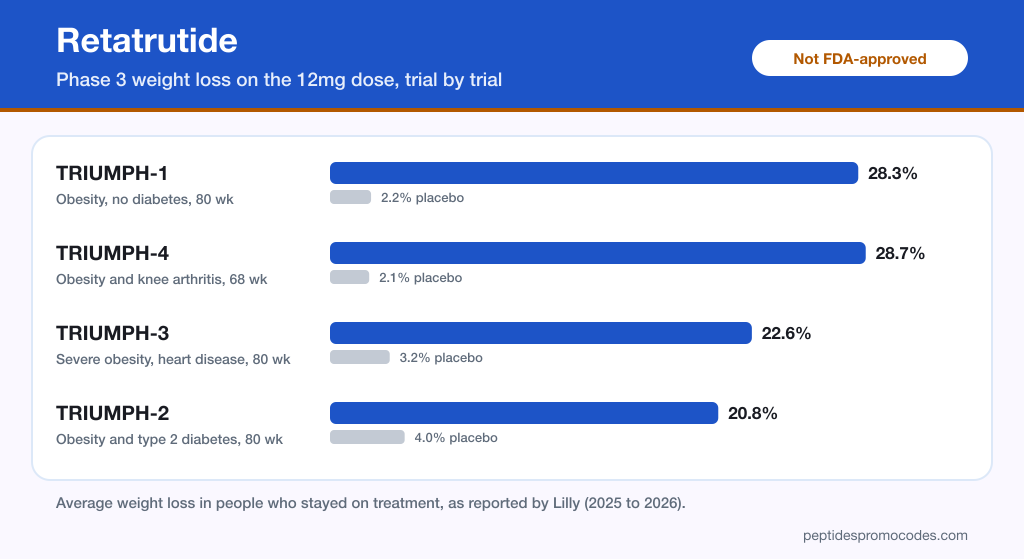
Retatrutide is an experimental weekly injection from Eli Lilly that acts on three hormone receptors: GLP-1, GIP and glucagon. It is the strongest weight loss drug tested so far. In its main phase 3 trial, TRIUMPH-1, adults on the 12mg dose lost 28.3% of their body weight on average over 80 weeks if they stayed on treatment, or 25.0% counting everyone who started.
As of September 2026, retatrutide is not approved anywhere. Lilly plans to file with the FDA in the first quarter of 2027. Products sold online as “reta” or “GLP-3” are research chemicals, not the medicine tested in the trials.
This guide covers every retatrutide trial result published so far, its side effects, how it compares with tirzepatide and semaglutide, and when it could reach pharmacies. It is general information, not medical advice.
Status checked on September 27, 2026.
Key Takeaways
- Phase 3 results: 28.3% average weight loss on 12mg in TRIUMPH-1 (80 weeks), 28.7% in TRIUMPH-4, 22.6% in TRIUMPH-3 and 20.8% in TRIUMPH-2, for people who stayed on treatment.
- The biggest losers: 45.3% of people on 12mg in TRIUMPH-1 lost at least 30% of their body weight.
- Side effects: mostly nausea, vomiting and diarrhea. Dysesthesia, an abnormal skin sensation, affected 12.5% of people on 12mg in TRIUMPH-1.
- Not yet compared head to head: a trial against tirzepatide, TRIUMPH-5, is due to finish in late 2026.
- Approval: Lilly plans to file in early 2027 and has not given a launch date or price.
- Research-grade “reta” varies widely: in independent testing, vials held from 51% to 190% of the labeled amount, and some failed identity tests entirely.
Buying for research? Jump to our verified retatrutide vendors and discount codes: up to 30% off, with third-party lab reports.
What Is Retatrutide?
Retatrutide (development code LY3437943) is a synthetic peptide that activates three hormone receptors at once: GLP-1, GIP and glucagon. That makes it a “triple agonist”. Tirzepatide (Zepbound) acts on two of these receptors, and semaglutide (Wegovy) on one.
It is a chain of 39 amino acids with a fatty acid attached, which binds it to albumin in the blood and slows its clearance. Its half-life is about 6 days, measured in a phase 1b trial, so it is injected once a week.
How retatrutide works
Each receptor does a different job:
| Receptor | What it does | Retatrutide’s strength vs the natural hormone |
|---|---|---|
| GIP | Works alongside GLP-1 on appetite and blood sugar | 8.9 times stronger |
| GLP-1 | Signals fullness, slows stomach emptying, lowers blood sugar | 0.4 times as strong |
| Glucagon | Raises energy use and fat burning in the liver | 0.3 times as strong |
The potency figures come from Lilly’s liver fat study (Nature Medicine, 2024). The glucagon effect is what sets retatrutide apart: in Lilly’s mouse studies, it raised energy use on top of the appetite reduction from GLP-1 and GIP. In people, it strongly reduces liver fat.
Is retatrutide a peptide or a biologic?
Retatrutide is a peptide, but whether it counts as a “biologic” is being fought in court. The FDA classed it as a regular drug in March 2024, because under its rules a protein must have more than 40 amino acids. Lilly counts 41 and wants it treated as a biologic, which would give it several more years of market exclusivity.
In December 2025, a federal court upheld the FDA’s finding that retatrutide is not a protein, but sent part of the case back to the agency. Lilly appealed, and the Seventh Circuit heard the case on September 24, 2026. The court’s docket shows extra briefs are due October 8, 2026, and no decision has been issued yet.
Retatrutide Results: The Phase 3 TRIUMPH Trials
Lilly has reported four phase 3 obesity trials, called TRIUMPH, plus a phase 3 diabetes trial. In each, people started on 2mg and stepped up every 4 weeks to their assigned dose.
| Trial | Who took part | Length | Weight loss on 12mg (stayed on it) | Counting everyone | Placebo |
|---|---|---|---|---|---|
| TRIUMPH-1 (May 2026) | 2,339 adults with obesity or overweight, no diabetes | 80 weeks | 28.3% | 25.0% | 2.2% |
| TRIUMPH-4 (December 2025) | 445 adults with obesity and knee osteoarthritis | 68 weeks | 28.7% | 23.7% | 2.1% |
| TRIUMPH-3 (July 2026) | 1,949 adults with severe obesity and heart disease | 80 weeks | 22.6% | Not reported | 3.2% |
| TRIUMPH-2 (July 2026) | 1,152 adults with obesity and type 2 diabetes | 80 weeks | 20.8% | Not reported | 4.0% |
“Stayed on it” counts people who kept taking the drug; “counting everyone” includes people who stopped, and is the fairer figure for comparisons. The phase 3 results come from Lilly’s announcements: none of the TRIUMPH trials has been published in a journal yet. TRIUMPH-2 is due to be presented at the EASD conference on September 30, 2026.
TRIUMPH-1, dose by dose
TRIUMPH-1 is the main trial Lilly will use for approval. Results at 80 weeks:
| Dose | Stayed on treatment | Counting everyone | Average pounds lost (stayed on) |
|---|---|---|---|
| 4mg | 19.0% | 17.6% | 47.2 lb |
| 9mg | 25.9% | 23.7% | 64.4 lb |
| 12mg | 28.3% | 25.0% | 70.3 lb |
| Placebo | 2.2% | 3.9% | 5.5 lb |
On 12mg, 62.5% of people lost at least a quarter of their body weight, 45.3% lost at least 30%, and 27.2% lost at least 35%. In a 104-week extension of 532 people with a BMI of 35 or more, average weight loss on 12mg reached 30.3% (85.0 lb).
Why you see 24%, 25%, 28% and 30%
Retatrutide’s headline figure depends on which trial and which way of counting a source uses:
- 24.2% is from the smaller phase 2 trial, at 48 weeks.
- 25.0% is TRIUMPH-1 at 80 weeks, counting everyone who started.
- 28.3% is TRIUMPH-1 at 80 weeks, counting people who stayed on treatment.
- 28.7% is TRIUMPH-4, a separate 68-week trial of 445 people with knee osteoarthritis.
- 30.3% is a 104-week extension of TRIUMPH-1 in 532 people with a BMI of 35 or more.
Retatrutide weight loss per week
Trials report weight loss at the end, not per week, and weight loss is fastest in the first months. As a rough average, TRIUMPH-1’s 70.3 lb over 80 weeks on 12mg works out to about 0.9 lb, or 0.35% of starting weight, a week.
Phase 2 and other results
Before phase 3, retatrutide was tested in smaller phase 2 trials:
- Obesity (NEJM, 2023): 338 adults lost 8.7%, 17.1%, 22.8% and 24.2% on 1mg, 4mg, 8mg and 12mg at 48 weeks, against 2.1% on placebo. Everyone on 12mg lost at least 5%.
- Type 2 diabetes (Lancet, 2023): on 12mg, HbA1c (average blood sugar) fell by 2.02 points at 24 weeks and weight by 16.9% at 36 weeks.
- Liver fat (Nature Medicine, 2024): in 98 people with fatty liver, liver fat fell 82.4% on 12mg at 24 weeks, and 86% had normal liver fat again, against 0% on placebo.
- Phase 3 diabetes trial (TRANSCEND-T2D-1, Lancet, 2026): over 40 weeks, HbA1c fell by up to 1.94 points and weight by up to 15.3%, counting everyone.
Sub-studies of TRIUMPH-1 also found large improvements in sleep apnea and knee pain.
Retatrutide vs Tirzepatide vs Semaglutide
No trial has compared retatrutide directly with tirzepatide or semaglutide yet. Across separate trials, counting everyone who started:
| Drug | Main trial | Length | Average weight loss (counting everyone) | Placebo | Status |
|---|---|---|---|---|---|
| Retatrutide 12mg | TRIUMPH-1 | 80 weeks | 25.0% | 3.9% | Not approved |
| Tirzepatide 15mg (Zepbound) | SURMOUNT-1 | 72 weeks | 20.9% | 3.1% | FDA-approved |
| Semaglutide 2.4mg (Wegovy) | STEP 1 | 68 weeks | 14.9% | 2.4% | FDA-approved |
Cross-trial comparisons are rough: TRIUMPH-1 ran 8 weeks longer than SURMOUNT-1, and the people enrolled differed. The head-to-head trial TRIUMPH-5, in 800 people, compares retatrutide with tirzepatide and is due to finish in December 2026. A diabetes trial against semaglutide is due in early 2027.
For how tirzepatide and semaglutide compare with each other, see our Mounjaro vs Wegovy guide.
Retatrutide Side Effects
Most side effects affect the gut and are worst while the dose is being increased. In TRIUMPH-1:
| Side effect | 4mg | 9mg | 12mg | Placebo |
|---|---|---|---|---|
| Nausea | 28.6% | 38.4% | 42.4% | 14.8% |
| Diarrhea | 25.2% | 34.1% | 32.0% | 13.5% |
| Constipation | 23.8% | 25.9% | 26.1% | 10.9% |
| Vomiting | 10.6% | 22.8% | 25.3% | 4.8% |
| Stopped because of side effects | 4.1% | 6.9% | 11.3% | 4.9% |
Dysesthesia
Dysesthesia is an abnormal skin sensation, often described as burning or tingling. It rises with the dose, and has also been seen with high-dose semaglutide: about 1 in 5 people on Wegovy HD 7.2mg reported it. On retatrutide:
| Trial | Retatrutide | Placebo |
|---|---|---|
| TRIUMPH-1 (4mg, 9mg, 12mg) | 5.1%, 12.3%, 12.5% | 0.9% |
| TRIUMPH-2 (4mg, 9mg, 12mg) | 4.5%, 5.6%, 7.3% | 0.7% |
| TRIUMPH-3 (9mg, 12mg) | 6.4%, 6.4% | 1.3% |
| TRIUMPH-4 (9mg, 12mg) | 8.8%, 20.9% | 0.7% |
Lilly describes the cases as generally mild to moderate, says most resolved during treatment, and says they rarely led people to stop. It has not explained the cause.
Heart rate and heart events
Heart rate rose with the dose in the phase 2 trial and peaked at 24 weeks. A 2026 analysis of that trial put the rise at about 6 beats per minute on 12mg at 48 weeks, against 0.4 on placebo. Lilly has not released phase 3 heart rate data.
In TRIUMPH-3, which enrolled people with heart disease, major heart events were less common than expected in both groups. There were 44 on retatrutide and 52 on placebo by Lilly’s broadest measure, a difference too small to be statistically meaningful either way. A 10,000-person heart and kidney outcomes trial, TRIUMPH-OUTCOMES, is due in 2029.
Other risks
In the phase 2 trials, a few people had serious events such as pancreatitis, gallbladder inflammation and atrial fibrillation, each in 1 or 2 people. Lilly has not released phase 3 figures for these, and retatrutide’s warnings will not be known until the FDA approves a label.
Retatrutide Dosage in Clinical Trials
These are the doses used in Lilly’s trials. They describe how the trials were run and are not dosing guidance: retatrutide has no approved dose.
- Phase 3 (TRIUMPH): everyone started at 2mg once a week and stepped up every 4 weeks, through 4mg, 6mg and 9mg, to a target of 4mg, 9mg or 12mg. The 80-week trials had a 16-week step-up period and 64 weeks at the full dose.
- Phase 2: doses of 1mg, 4mg, 8mg and 12mg were tested. Starting at 2mg rather than 4mg reduced gut side effects.
- Dose reductions: the phase 3 protocols allowed doses to be lowered for gut side effects, a BMI of 22 or below, or excessive weight loss.
No trial has tested “microdosing”. The lowest doses tested were 0.5mg in a diabetes trial, which did not lower weight more than placebo, and 1mg in the obesity trial, which led to 8.7% weight loss at 48 weeks. A maintenance trial, TRIUMPH-6, is testing lower doses after weight loss, with results due in 2028.
When Will Retatrutide Be Approved?
Lilly plans to submit retatrutide to the FDA in the first quarter of 2027, according to its second-quarter 2026 results. A standard FDA review takes about a year from submission, so an approval would most likely come in 2028. Lilly has not given a launch date.
It is not approved in the UK either: the MHRA said in July 2026 that retatrutide “has not been authorised for use in the UK”.
Retatrutide price
Lilly has not announced a price. Its retatrutide FAQ says the price will “reflect the overall value to the healthcare system”. For comparison, Lilly’s tirzepatide (Zepbound) costs $299 to $699 a month self-pay in 2026.
How to join a retatrutide trial
Joining a trial is the main legal way to take retatrutide before approval. The large TRIUMPH weight loss trials have finished recruiting, but Lilly is still running newer retatrutide studies. You can search for studies recruiting near you on ClinicalTrials.gov or Lilly’s trial finder.
Early access
Lilly runs a limited expanded access program for patients who cannot join a trial. It is for adults with a BMI of 35 or more despite the highest available dose of an approved weight loss medicine, and with two or more serious obesity-related conditions. A doctor must apply on the patient’s behalf; patients cannot apply directly.
“Reta” and “GLP-3”: Research-Grade Retatrutide
“Reta” is shorthand for retatrutide. “GLP-3” is a nickname for its three targets: there is no hormone called GLP-3, and Lilly calls the term “scientifically inaccurate”. Online vendors sell research-grade retatrutide as freeze-dried powder in vials, labeled for laboratory research use only, under names such as “GLP-3 RT”, “GLP-3R” and “RETA”.
Research-grade retatrutide is not the medicine tested in the TRIUMPH trials. Lilly said in August 2026 that “no medicine containing retatrutide has yet been approved for human use by any regulatory agency in the world”. It has filed six lawsuits, four against research-peptide sellers, and reported more than 14,000 online listings. The FDA says retatrutide “cannot be used in compounding under federal law” and has sent warning letters to online sellers.
Is retatrutide legal to buy in the US?
Not as a medicine. Retatrutide is not approved, pharmacies cannot compound it, and the FDA treats products sold for human use as illegal unapproved drugs, whatever their label says. Lilly’s August 2026 lawsuits target sellers that “falsely claim their drugs are for ‘research-use only’ when they are actually intended for human use”. The legal routes to take retatrutide are Lilly’s trials and its early access program. Research-grade vials are sold for laboratory research only.
Some sellers point to retatrutide listings on DailyMed, the US drug label database. These are self-submitted listings from overseas companies, marked “export only”, and are not FDA approvals.
Why the lab report matters
Independent tests show why the batch lab report matters more for retatrutide than for almost any other peptide:
- Australia, 2026: three vials labeled 10mg all contained retatrutide, but held 5.1mg, 19.0mg and 16.5mg, or 51% to 190% of the label, according to a study in Drug and Alcohol Review.
- Finnrick, a commercial testing service: of its 200 most recent public retatrutide tests (August to September 2026), 54 failed. In 43 of those, the lab could not confirm the vial contained retatrutide at all, according to its retatrutide results page.
- FDA reports: the FDA’s adverse event database held 44 reports naming retatrutide by July 2026, 33 of them serious, most often vomiting, nausea and a raised heart rate. Reports alone do not prove the drug caused the problem.
A certificate of analysis (COA) from a named third-party lab, matching the batch number on the vial, is the best check available. Our guide to reading a peptide COA explains what to look for.
Where to Buy Research-Grade Retatrutide
If you are sourcing retatrutide for laboratory research, these seven vendors from our directory stock it. On September 27, 2026, we checked each one’s retatrutide lab reports and prices. All publish at least one third-party report, but the reports test different things, so the table shows exactly what each one covers. None of them is among the six sellers Lilly sued in August 2026.
| Vendor | Sizes | 10mg price | Discount | Latest retatrutide lab report |
|---|---|---|---|---|
| PSPeptides | 5mg to 60mg | $69.99 | Code NOW10OFF: 10% off, stacks with 2- and 3-vial bundle savings |
North American Diagnostics, August 2026: 10.06mg in a 10mg vial, 99.94% pure. Endotoxin, sterility, heavy metals and fentanyl screens passed, and the report can be checked on the lab’s website |
| American Peptides | 10mg to 60mg | $105.00 | Code ABRAR10: 10% off; volume pricing up to 16% off |
Bioviridian, August 2026: 10.61mg in a 10mg vial, 99.83% pure, with endotoxin and heavy metals tested. There is a report for every size, matching the lab’s own records |
| Arizen BioLabs (as ABL-3 RT) | 10mg to 50mg | $69.99, or $49.99 with FALL30 |
Code FALL30: 30% off during its fall sale (backup code QUICK: 10% off) |
Freedom Diagnostics, July 2026: 99.83% pure, endotoxin passed. The tested lot was labeled 20mg, a size not currently sold |
| Alera Research (as GLP-3R) | 10mg, 20mg | $69.99 | Sitewide sale, plus up to 12% off when you buy 6 or more | Freedom Diagnostics, March 2026: 12.52mg in a 10mg vial, 99.85% pure |
| Peptide Confidential (as RETA) | 20mg, 30mg | 20mg: C$150 (about US$106) | No code needed: 10% off each vial at 3 vials, 20% at 5, 30% at 10 | Peptide Test Canada, August 2026: 22.41mg in a 20mg vial, 99.8% pure. It also publishes failed batches: its 10mg and 60mg lots were rejected in September and are not for sale |
| Healius Peptides | 5mg, 10mg, 20mg | $89.95 | Code abrar10: 10% off sitewide |
Janoshik, May 2026: 9.16mg in a 10mg vial, 99.64% pure |
| 99 Purity Peptides | 10mg to 60mg, plus 5- and 10-vial kits | $79.99 | Code PPEPTIDESPC10: 10% off sitewide |
Eagle Analytical, June 2026: sterility and endotoxin passed. No published purity or content test for retatrutide |
At the 10mg size, research-grade retatrutide cost $69.99 to $105, or $7 to $10.50 per mg, before discount codes. Prices and sales change often, so check the store before you order. Our PSPeptides promo code guide shows how NOW10OFF stacks with its bundle pricing. Full terms for each code are on the vendor’s listing: PSPeptides, American Peptides, Arizen BioLabs, Alera Research, Peptide Confidential, Healius Peptides and 99 Purity Peptides.
Research-grade retatrutide is not the medicine tested in the TRIUMPH trials. It is sold for laboratory research use only, not for human use. The store links above are referral links: we may earn a commission at no extra cost to you, and it never affects which vendors we list.
Before you order, match the batch number on the lab report to the vial you are buying. Our guides to peptide testing labs and spotting peptide scams explain what to check, and the buyer’s guide covers how we vet suppliers.
Frequently Asked Questions
What is retatrutide?
Retatrutide is an experimental weekly injection from Eli Lilly that activates three hormone receptors: GLP-1, GIP and glucagon. It is being developed for obesity, type 2 diabetes and related conditions. It is not approved anywhere as of September 2026.
How much weight can you lose on retatrutide?
In the phase 3 TRIUMPH-1 trial, people on the 12mg dose lost 28.3% of their body weight on average over 80 weeks if they stayed on treatment, about 70 lb. Counting everyone who started, the average was 25.0%. Nearly half lost at least 30%.
Is retatrutide FDA-approved?
No. Lilly plans to submit it to the FDA in the first quarter of 2027. A standard review takes about a year, so an approval would most likely come in 2028.
Is retatrutide stronger than tirzepatide?
Probably, but it has not been tested head to head yet. Counting everyone who started, retatrutide 12mg led to 25.0% weight loss at 80 weeks in TRIUMPH-1, against 20.9% at 72 weeks for tirzepatide 15mg in SURMOUNT-1. A direct comparison, TRIUMPH-5, is due to finish in December 2026.
What are the side effects of retatrutide?
The most common are nausea, diarrhea, constipation and vomiting. Dysesthesia, a burning or tingling skin sensation, affected 12.5% of people on 12mg in TRIUMPH-1. Heart rate also rose slightly with the dose in phase 2. About 11% of people on 12mg stopped because of side effects.
What is GLP-3?
“GLP-3” is a nickname for retatrutide, used mostly by online sellers. There is no hormone called GLP-3: the name refers to retatrutide acting on three receptors. Lilly calls the term scientifically inaccurate.
Is it legal to buy retatrutide?
Not as a medicine in the US. It is not approved, it cannot be compounded, and the FDA has warned sellers that market it for human use. The legal ways to take it are Lilly’s clinical trials and its early access program. Research-grade vials are sold for laboratory research only.
How long does retatrutide stay in your system?
Retatrutide’s half-life is about 6 days, measured in a phase 1b trial. That means half of a dose is still in the body after about 6 days, which is why it is injected once a week.
What doses of retatrutide were used in trials?
In phase 3, people started at 2mg once a week and increased every 4 weeks to a target of 4mg, 9mg or 12mg. This describes the trial design; retatrutide has no approved dose.
How much will retatrutide cost?
Lilly has not announced a price. For comparison, its tirzepatide (Zepbound) costs $299 to $699 a month self-pay in the US in 2026.
Where can I buy research-grade retatrutide?
Seven verified vendors in our directory sell research-grade retatrutide for laboratory research use, each with published third-party lab reports. PSPeptides publishes the most complete testing. Our codes take 10% off at American Peptides (ABRAR10), PSPeptides (NOW10OFF), 99 Purity Peptides (PPEPTIDESPC10) and Healius Peptides (abrar10), and 30% off at Arizen BioLabs (FALL30) during its fall sale.
For the wider picture, see our ranking of the best peptides for weight loss.
Sources
Trials and studies
- Lilly: retatrutide TRIUMPH-1 results (May 2026)
- Lilly: retatrutide TRIUMPH-2 and TRIUMPH-3 results (July 2026)
- Lilly: retatrutide TRIUMPH-4 results (December 2025)
- Triple-Hormone-Receptor Agonist Retatrutide for Obesity: A Phase 2 Trial (NEJM, 2023)
- Retatrutide in people with type 2 diabetes: a phase 2 trial (Lancet, 2023)
- Retatrutide in people with type 2 diabetes: TRANSCEND-T2D-1 (Lancet, 2026)
- Retatrutide and liver fat in people with obesity: phase 2 substudy (Nature Medicine, 2024)
- Retatrutide phase 1b trial in type 2 diabetes (Lancet, 2022)
- LY3437943, a novel triple agonist: discovery and preclinical studies (Cell Metabolism, 2022)
- Heart rate changes with retatrutide: meta-analysis (Eur J Med Res, 2026)
- TRIUMPH-5: retatrutide vs tirzepatide (ClinicalTrials.gov)
- Retatrutide expanded access program (ClinicalTrials.gov)
- Tirzepatide Once Weekly for the Treatment of Obesity (SURMOUNT-1, NEJM, 2022)
- Once-Weekly Semaglutide in Adults with Overweight or Obesity (STEP 1, NEJM, 2021)
Regulation and the research market
- Lilly: second-quarter 2026 results, including retatrutide filing plans
- Lilly: what to know about retatrutide (July 2026)
- Eli Lilly and Company v. Kennedy, Seventh Circuit docket (CourtListener)
- Lilly on the illegal retatrutide market (August 2026)
- FDA’s concerns with unapproved GLP-1 drugs used for weight loss (FDA, September 2026)
- No summer shortcut for safe weight loss (MHRA, July 2026)
- Composition and labelling accuracy of retatrutide sold in Australia (Drug and Alcohol Review, 2026)
- Retatrutide test results (Finnrick)