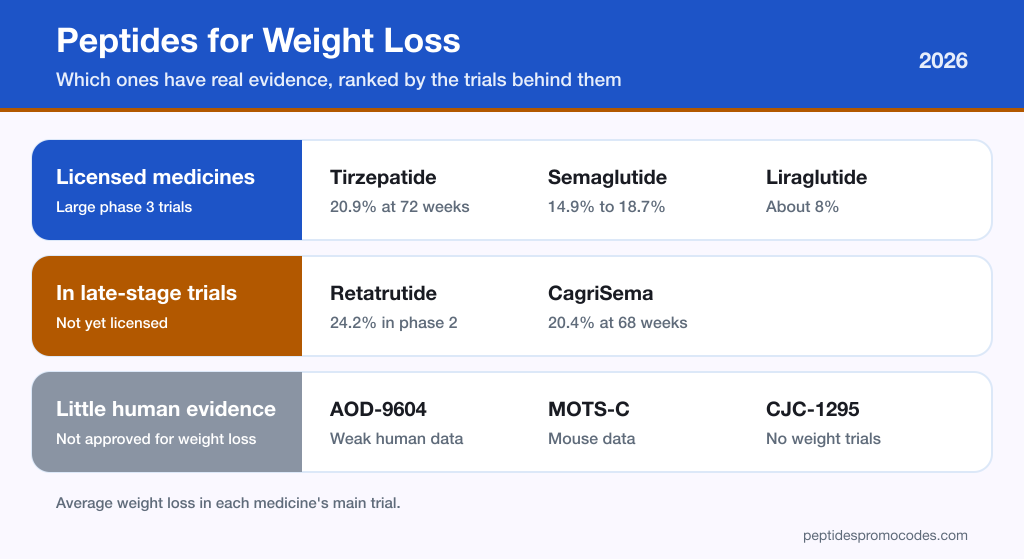
“Peptides for weight loss” can mean two very different things. It can mean licensed medicines such as Mounjaro and Wegovy, tested in trials with thousands of people. It can also mean unlicensed compounds sold online as “research peptides”, many with no human weight loss data at all.
Both are peptides, so the word alone tells you nothing about whether something works or is safe. This guide sorts the weight loss peptides you are likely to hear about by the strength of their evidence.
It is general information, not medical advice. Weight loss medicines need a prescriber’s assessment.
What Makes Something a Peptide?
A peptide is a short chain of amino acids, the same building blocks that make up proteins. Proteins are long chains that fold into complex shapes; peptides are short enough to act as precise chemical messengers. Our guide to peptides vs proteins explains the difference in more detail.
Your body makes many peptide hormones, including insulin and the gut hormones that control appetite. The most effective weight loss peptides are modified copies of those appetite hormones, built to last for days instead of minutes.
Licensed Peptide Medicines for Weight Loss
Three peptides are licensed for weight management in the UK, according to the regulator, the MHRA. All are prescription-only and all act on the GLP-1 receptor, the target of a gut hormone that signals fullness and slows how fast the stomach empties.
| Medicine | Peptide | How it is taken | Average weight loss in its main trial |
|---|---|---|---|
| Mounjaro | Tirzepatide | Weekly injection | 20.9% at 72 weeks on 15mg |
| Wegovy | Semaglutide | Weekly injection, or a daily pill | 14.9% at 68 weeks on 2.4mg; 18.7% at 72 weeks on 7.2mg |
| Saxenda and other brands | Liraglutide | Daily injection | About 8% at 56 weeks |
The trials behind these figures:
- Tirzepatide also acts on a second gut-hormone receptor, GIP. In SURMOUNT-1 (NEJM, 2022), the 15mg dose led to 20.9% average weight loss, against 3.1% on placebo.
- Semaglutide 2.4mg led to 14.9% average weight loss in STEP 1 (NEJM, 2021), and a higher 7.2mg dose reached 18.7% in STEP UP (2025). In the SELECT trial, it also cut major heart events by 20% in people with heart disease.
- Liraglutide was the first GLP-1 medicine licensed for weight loss. In the SCALE trial (NEJM, 2015), people lost 8.4kg on average, against 2.8kg on placebo.
When tirzepatide and semaglutide were compared directly, tirzepatide led to more weight loss on average. Our Mounjaro vs Wegovy guide covers that trial, the doses and the side effects.
In Late-Stage Trials, Not Yet Licensed
Two newer peptide treatments have strong early results but are not licensed medicines in the UK:
- Retatrutide acts on three receptors: GLP-1, GIP and glucagon. In its phase 2 trial (NEJM, 2023), the 12mg dose led to 24.2% average weight loss at 48 weeks, against 2.1% on placebo. Heart rate rose with the dose, peaking at 24 weeks. Larger phase 3 trials are testing it in thousands of people.
- CagriSema pairs semaglutide with cagrilintide, a copy of the appetite hormone amylin. In the REDEFINE 1 trial (NEJM, 2025), it led to 20.4% average weight loss at 68 weeks, against 3.0% on placebo. Gut side effects affected about 80% of people taking it.
You may also hear about orforglipron (Foundayo), a daily GLP-1 pill. It is a small molecule, not a peptide.
Retatrutide and cagrilintide are already sold online as “research peptides”, years ahead of any licence. Those products are not the medicines tested in these trials; see the section on research peptides below.
Popular Peptides with Little or No Human Evidence
These names come up often in forums and online shops. None is approved as a weight loss treatment:
- AOD-9604 is a fragment of human growth hormone, promoted as a fat burner. It reduced weight gain in obese mice, but short human trials gave little usable evidence, and it is not approved by any major regulator for any use, according to a 2026 review in Frontiers in Endocrinology. The US FDA lists it among substances with significant safety concerns for compounding pharmacies.
- CJC-1295 and ipamorelin raise the body’s own growth hormone. The same review found human studies on hormone levels, but none on body composition or weight loss. It also noted side effects reported with this group, including raised prolactin and cortisol, fluid retention and blood sugar problems.
- MOTS-C is a peptide made by mitochondria. The research is mostly in cells and mice: in the first major study (Cell Metabolism, 2015), it prevented diet-induced obesity in mice. It has not shown weight loss in controlled human trials.
- BPC-157 is often sold alongside weight loss peptides, but it is studied for tissue repair, not weight. A 2025 systematic review found 35 animal studies, one small human study and no clinical safety data.
Collagen peptides are also not weight loss treatments. They add protein to your diet, which can help you feel full, but they do not act like GLP-1 medicines and have no comparable weight loss data.
What About Research Peptides Sold Online?
Many online stores sell peptides such as tirzepatide, retatrutide and semaglutide as freeze-dried powder in vials, labelled “for research use only”. That label means the product is sold for laboratory research and is not approved for use in people.
The MHRA is clear on this for GLP-1 medicines: genuine products come as pre-filled pens or tablets, and powder in vials that has to be mixed before injecting is not an authorised medicine and poses significant health risks. It has also warned about counterfeit pens that look like the real thing.
Research products are not made or checked to medicine standards, so the dose, purity and sterility depend entirely on the seller. If you do buy research peptides for lab work, our guides to reading a peptide COA and spotting peptide scams explain what to check.
Side Effects of the Licensed Peptides
For tirzepatide, semaglutide and liraglutide, the common side effects are well documented and mostly affect the gut: nausea, diarrhoea, constipation and vomiting, especially in the first weeks and after dose increases. They usually ease with time.
The MHRA’s guidance also covers rarer risks and practical points:
- Pancreatitis: rare but sometimes serious. Severe stomach pain that spreads to the back needs urgent help.
- Eyesight: semaglutide has very rarely been linked to an eye condition called NAION. Seek urgent help for any sudden change in vision.
- Pregnancy: none of these medicines should be used in pregnancy. Stop semaglutide at least 2 months, and tirzepatide at least 1 month, before trying to conceive.
- The pill: tirzepatide may make oral contraceptives less effective. Add a barrier method for 4 weeks after starting and after each dose increase, or switch to a non-oral method.
How to Get a Licensed Weight Loss Peptide Safely
In the UK, all GLP-1 medicines are prescription-only. You can get them through the NHS if you meet its criteria, or privately after a consultation with a prescriber. Check that an online pharmacy is registered with the General Pharmaceutical Council before you order.
If you are in the UK, SheMed runs a clinician-led weight loss programme for women that prescribes licensed GLP-1 medicines. Our code NOW20OFF takes 20% off your first month; see our SheMed listing.
Frequently Asked Questions
What is the best peptide for weight loss?
On current evidence, tirzepatide (Mounjaro). It led to 20.9% average weight loss at 72 weeks in its main trial and beat semaglutide in a head-to-head trial. Semaglutide (Wegovy) is close behind at its higher 7.2mg dose. The right choice depends on your health and how you tolerate each medicine.
Do peptides actually help you lose weight?
Some do. The licensed GLP-1 peptides produce large, well-proven weight loss. Most other peptides marketed for fat loss, such as AOD-9604 or MOTS-C, have little or no evidence in people.
Is AOD-9604 a good peptide for weight loss?
There is no good evidence that it works in people. It reduced weight gain in mice, but human trials gave little usable evidence, and no major regulator has approved it.
Is retatrutide available?
Not as a licensed medicine. It is still going through phase 3 trials. Products sold online as retatrutide are research chemicals, not the medicine tested in trials.
Are collagen peptides good for weight loss?
Not on their own. They are a protein source and may help you feel full, but they have no weight loss effect comparable to GLP-1 medicines.
Can I buy weight loss peptides without a prescription?
Not legally as medicines in the UK. Licensed GLP-1 peptides need a prescription, and the MHRA warns that GLP-1 products sold as powder in vials are not authorised medicines.
Sources
- GLP-1 medicines for weight loss and diabetes: what you need to know (MHRA, updated February 2026): which GLP-1 medicines are licensed, safety warnings and buying advice.
- Tirzepatide Once Weekly for the Treatment of Obesity (SURMOUNT-1, NEJM, 2022)
- Once-Weekly Semaglutide in Adults with Overweight or Obesity (STEP 1, NEJM, 2021)
- Once-weekly semaglutide 7.2 mg in adults with obesity (STEP UP, Lancet Diabetes & Endocrinology, 2025)
- Semaglutide and Cardiovascular Outcomes in Obesity without Diabetes (SELECT, NEJM, 2023)
- A Randomized, Controlled Trial of 3.0 mg of Liraglutide in Weight Management (SCALE, NEJM, 2015)
- Triple-Hormone-Receptor Agonist Retatrutide for Obesity: A Phase 2 Trial (NEJM, 2023)
- Coadministered Cagrilintide and Semaglutide in Adults with Overweight or Obesity (REDEFINE 1, NEJM, 2025)
- The emerging landscape of performance-enhancing peptides modulating the GH-IGF1 axis (Front Endocrinol, 2026): evidence tiers for AOD-9604, CJC-1295, ipamorelin and related peptides.
- The mitochondrial-derived peptide MOTS-c promotes metabolic homeostasis and reduces obesity and insulin resistance (Cell Metab, 2015): the mouse study behind MOTS-C’s fat-loss claims.
- Emerging Use of BPC-157 in Orthopaedic Sports Medicine: A Systematic Review (HSS Journal, 2025)
- Peptides for Weight Loss (SheMed, 2026): a UK clinical pharmacist’s overview of licensed and unlicensed weight loss peptides.